Tuesday, September 30, 2008

ASW Weapons; Part I

At the turn of the 20th Century, a new development was coming into the naval scene: Steam turbines. Until then, the fastest screw-driven (ships are driven by screws, boat and airplanes use propellers) ships might approach 20 knots by the use of triple-expansion steam engines. Those engines used large pistons and crankshafts.

At the close of the 19th century, the Royal Navy unveiled a very fast boat named the Turbinia at the Fleet Review which was put on for Queen Victoria's diamond jubilee. Turbinia was the first successful craft driven by a steam turbine. Turbinia could reach nearly 35 knots, making her almost twice as fast as any other craft afloat.

During the era when the steam turbine was being developed, torpedoes were being developed. The first craft to carry torpedoes were light, fast boats. Somewhat larger ships, almost as fast, but more heavily armed, were developed to protect large capital ships from the threat of the torpedo boats; these ships were known as "torpedo boat destroyers." Torpedo boats would be used in wars through the Second World War. Torpedoes were also launched from larger surface ships, the Japanese "Long Lance" was the best in the world and was an extremely effective weapon. Torpedoes came into their most renown use as an antiship weapon launched from submarines, for they could be fired from periscope depth, giving the submarine the greatest possible concealment.

However, there was, at first no weapon specifically designed to fight a submarine. Gunfire was ineffective against a submerged submarine; shooting at the periscope was akin to trying to hit a broomstick at 500 yards with a rifle. And so, the first practical ASW weapon was developed: The depth charge.

The first depth charges were little more than cans filled with explosives. In a day when most buildings were heated with coal-fired furnaces, the furnaces had to be routinely cleaned of its ashes, which were put into large steel cans, or "ash cans." The depth charges were about the same size; they became known as "ash cans."
The early depth charges ones had 50lbs of explosive; by the end of World War I, they had up to 600lbs. The technique was simple: Go to where the submarine was and roll the charges off the stern of the ship. The depth charges had a delay timer, often set by depth, to prevent blowing the stern out of the water. If the skipper had an idea which way the submarine was heading, he could try to "lead" the submarine.

In order to get a wider pattern, the Y gun was developed. The Y gun threw two depth charges, one to either side of the ship.

The K gun threw one depth charge:


In the event that a submarine attacked the escort, the drill was to charge directly at the submarine at high speed (steam turbines, remember), which presented a narrow target for the sub to shoot at. If the sub was on the surface or had its periscope up, the bow guns of the destroyer would shoot at it to force the submarine below the surface. The subs of the day ran on diesels while on the surface and on batteries when submerged. The subs had to run slowly on batteries in order to conserve power, so if the destroyer could get to where the submarine was last seen (the "datum") very quickly, the destroyer would lay down a pattern of depth charges. If the submarine submerged too slowly the destroyer would ram it.

Depth charges killed in two ways. One was by concussion, which you have no doubt seen in any number of old war movies. But if the depth charge was close enough, the sub would be shattered. When an underwater charge detonates, it blows a circular bubble in the water as wide as water pressure will allow. The bubble then collapses to its center and bounces back out; this cycle repeats until it runs out of energy. But if as the bubble expands it touches a solid object, like a submarine, the bubble will collapse onto that object and blow the living shit out of it.

But there were serious drawbacks to the use of depth charges.

(To be continued)

Wednesday, September 24, 2008

Where Do They Find Such People?

If you wanted to enlist in the Navy back in the day, you just strolled into your local recruiter and chatted him (or her) up. You'd take the ASVAB (Armed Services Vocational Aptitude Battery) test, fill out some forms, take a physical, and off you'd go. The big determiners on what you did were the needs of the Navy and your ASVAB score, with added pluses for relevant experience. If your requested skill required that you'd have to learn a foreign language, you also had to take the Defense Language Aptitude Battery (DLAB) test.

Then it was off to the Recruit Training Centers, known throughout the Navy as "boot camps." There were three of them, RTC Orlando, RTC San Diego and RTC Great Lakes. If you had scored well on the ASVAB and there were slots open, you would go from boot camp to "A School" to learn the basics of a technical rating. If you couldn't get what you wanted, you would be sent to the Fleet as an undesignated seaman (deck), fireman (engineering) or airman (carriers). There you would take a correspondence course in the rating you wanted to get into, or "strike for." You would have to demonstrate your interest and ability to the Striker Selection Board in order to be transferred into that division. And, most important, you had to impress that division that you'd be a good addition, as nobody wanted to be saddled with a dirtbag.

For officers, there were several routes.

Oldest of all: The Naval Academy (USNA) in Annapolis, MD, the official brain washer of the officer corps, also referred to as the Boat School or the Chesapeake University of Nautical Technology. Their job was to produce the Kool-Aid Drinkers, the ones most likely to make a career out of it. USNA grads were the ones most likely to treat rules and regulations as Holy Writs. You could enlist, then apply for the Academy. In that event, you normally had to first go to the USNA Prep School in Newport, RI. They had a five year commitment after being commissioned.

The Reserve Officer Training Corps (ROTC): They produced more officers than did the USNA. The ones on scholarships got all of the benefits of going to Annapolis (a free education), without the stringent 24/7 horseshit. If you wanted the free education, but you wanted to be able to drink copious amounts of beer and have frequent sex, you went to ROTC. 2 year ROTC grads had a four year commitment, 4-year ROTC grads had a five year commitment.

Both 4-year ROTC and USNA midshipmen went to sea serving as enlisted sailors during the summer between their freshman and sophomore years. Between their junior and senior years, they went to sea as junior officers. Between their sophomore and junior years, they went to play with the Marine Corps and/or the aviators.

Officer Candidate School (OCS): OCS was open to those who already had a 4-year college degree. The aviators had their OCS at Penascola, FL. Almost everyone else went to OCS in Newport, RI. This was a 19-week cram course that later was reduced to 16 weeks by increasing the class day from seven hours to eight hours. These were the "90 day wonders." A sailor in the Navy who had earned a degree could apply to go to OCS and many did. A fair number of enlisted from all services who had gotten out and then earned a degree went to OCS. The non-prior service OCs tended to have a few years of experience after college, some had master's degrees. OCS grads had a four-year commitment, though the ones who went off to nuclear school had a longer commitment.

Officers who went to USNA tended to stay in in greater percentages, as they were the ones who had been brainwashed. Those who went to OCS tended to leave after their initial service was done, as they saw the Navy more as "just another shitty job." OCS graduates were far less likely to have drunk the Kool-Aid than the others. OCS grads were the ones most likely to think outside of the box; they could be the superstars or the problem children of any wardroom. If you needed something done that was not usual procedure or might even be borderline on legality, you probably asked an OCS grad to do it. ROTC officers tended to fall in between the two extremes, but they tended to be more towards the OCS side of the spectrum.

Officer Indoctrination School (OIS): OIS was a four or six week school in little more than how to wear a uniform and not make an utter fool of yourself. OIS was only open to staff corps; people who had a skill the Navy needed, were not in line to command anything and were less likely to be sent to sea (baby supply pukes were sent to OCS). Doctors, nurses, chaplains and lawyers went to OIS. If the Navy needed them badly enough, they were given direct commissions, shown briefly how to wear a uniform and set loose. The results were often comical.

Limited Duty Officers (LDO): LDOs were senior enlisted who were directly commissioned as line officers. Because LDOs often had ten or more years of service, most retired soon after being promoted to lieutenant commander.

Post commissioning training for officers will be a topic for another day.

Thursday, September 18, 2008

Naval Gunfire Support

Navy frigates, cruisers and destroyers all are equipped with naval rifles, also referred to as "guns." "Guns" are what the Army and landlubbers refer to as "cannons." Since the retirement of the last of the WW2 8" gun cruisers in the 1970s, and until the introduction of the Perry Class FFGs, FFs, DDs and CGs all carried 5" guns. Now FFGs have 76mm guns and 5" guns are on DDGs and CGs.

Those guns are "dual-purpose" guns, which means that they can shoot at targets both on the sea and in the air. Dual-purpose guns were developed after WWI when it became clear that ships might need to shoot at airplanes. That avoided having to add large guns solely for anti-aircraft uses, which helped to reduce the growth in topside weight. The more weight added above the main deck (actually, above the center of gravity), the less stable a ship is.

Besides shooting at other ships and at airplanes and now missiles, the guns are also used to provide supporting fire to Marines on the beach. That is the naval gunfire support mission, or "NGFS."

NGFS is primarily indirect fire, in that the ship does not spot and direct its own fire. Naval gunfire spotters do that and they were often naval officers (but not always). Being sent to duty as a gunfire spotter, at least in the post-Vietnam peacetime era, was a clear sign that one had royallly screwed the pooch, that one's career was over. Back then, the Navy was not going to send an up-and-coming young surface warfare officer to go play with the Marines and live in the dirt and eat bugs. But if you were a fuckup and you were either too dumb or too stubborn to submit your resignation towards the end of your first sea tour, off you went to play jarhead.

So let's think about how you actually do spotting. If you are the observer, what you have is a land map, a compass, a pair of binoculars and a radio. You would radio the ship, give your grid position (it was in your best interests to be particularly accurate), give the range and magnetic bearing to the target, describe the target, tell the ship what type of shell to fire and then tell them when to shoot.

So it would be something like "Ship, observer target line zero-six-six, range one two zero zero, target: trucks in open, VT frag, over.". The radio talker in the ship's Combat Information Center would read that back to the spotter. If it was correct, the spotter would say: "Fire when ready." The NGFS team in CIC would plot the observer's position and determine the range and bearing to the target. The range and bearing would be called down to Gun Plot, read back to CIC, and then a round would be fired. When the round was fired, the R/T talker would call out "Shot" and then, five seconds before impact, would follow that with "splash, out."

The spotter would then call back corrections from his point of view, with all distances in meters: "Left five zero, add two zero zero, fire when ready." That had to be corrected by what probably should have been called a "gunfire plotting board," but which everyone referred to as a "Comanche Board." These were two coaxial bearing rings, each with a clear plexiglas surface inside the ring, so that the inner ring's surface was on top of the outer ring. The surfaces were marked in a grid pattern, with each line representing ten meters. The outer ring would be turned so that its grid were aligned on the observer-target line, the inner ring was turned so that its grid were aligned on the ship-target line. The grids were different color, often black and red. The center point was the aiming spot for that round.

The CIC plotters would plot "left 50, add 200" on the observer grid, note what that correction was on the ship's grid and call that down to Gun Plot for another spotting round. Ideally, the third round would be close enough and then the ship would commence area fire. The two common rounds used were VT frag, against troops, tanks and trucks, and White Phosphorus, against troops. VT frag would not do much damage to tanks, but what it did was force the tank commanders to drop inside and "button up," where it is harder for the tank commanders to see what is going on. You might get really lucky and blast off a radio antenna from a tank, break a tank's tread or smash a vision block.

Until a few years ago, most Atlantic Fleet ships did their NGFS training at Vieques, Puerto Rico. Bloodsworth Island in Chesapeake Bay was also used, but infrequently, due to the prevalence of civilian boats in the Bay. If I remember correctly, it was not permitted to shoot anything other than inert shells at Bloodsworth, while live ordnance was permitted at Vieques. NGFS is no longer done at Vieques, I have no idea where live NGFS training is done, if it is indeed done at all anymore.

Thursday, September 11, 2008

More Reading

If you want to read sea stories from the 1950s and early 1960s, look in the library for fiction written by Daniel V. Gallery. You may be able to find "Cap'n Fatso", "Stand By-y-y to Start Engines," or "Now Hear This," which were among his fictional works.

Gallery was the commander of the task group that captured U-505. Rumor has it that when the Chief of Naval Operations, Admiral King, received reports of the capture, his first inclination was to order that Gallery be court-martialed and shot. King knew the value of the intercepts that the Americans and British were reading because they had broken the German naval Enigma code and that if the Germans found out that U-505 had been captured, they would change their codes.

Wednesday, September 10, 2008

Zulu Five Oscar

There are, as you might imagine, a lot of different drills and exercises in the Navy. The ones that are done for scoring against (or by) the ship have letter and number designations that correlate to some scheme that I have long since forgotten.

One sticks with me: Zulu-5-Oscar. A Z-5-O is a shipboard security drill in which a person who is not a member of the ship's company tries to get aboard and roam around the ship unescorted. Most of the the time, the drill is successful from the ship's perspective in that the person trying to get on board is caught.

This is no shit:

There was one Command Duty Officer who got the word that a Z-5-O was going to be run against his ship on his duty day by another ship. He corralled a young sailor from that ship and sent him back with this word: "I've had enough of this shit. I'm gonna sit by the Quarterdeck with a shotgun and I'm gonna shoot the fucker who tries to pull a Zulu-Five-Oscar on me."

The CDO ordered the duty gunner's mate to give him a shotgun and he sat on the fantail's capstan, right by the Quarterdeck. Sure enough, about 90 minutes later, a nervous looking sailor walked about halfway up the gangway, threw his hands high over his head and screamed: "Zulu-Five-Oscar! You caught me! Don't shoot!"

Second story:

Again, one ship was tasked with trying to run a Z-5-O on another. A lieutenant (JG) volunteered to do it. He went to the uniform shop and purchased a set of shoulder boards for the summer white uniform. The shoulder boards were for a lieutenant in the Chaplain Corps. He put those and a briefcase with some religious literature in his car. The day of the Z-5-O, he went out to his car, switched his shoulder boards to the chaplain's ones, picked up his briefcase, and walked to the ship he was assigned to run the drill on. Once he got on board, he told the OOD that he was Chaplain O'Hara from the destroyer squadron.

If the quarterdeck watch had been on the ball, they would have noticed that his ID card was for a LTJG of a different name. They would have noticed that there was no Chaplain O'Hara on the Desron access list. What they did do is call the XO and tell him that Chaplain O'Hara was there from the Squadron. The XO told them to send the chaplain to the wardroom, so they gave him an unescorted visitor's badge and let him go.

And so he did. He wandered to the wardroom, tucking a few 3x5 cards behind cable runs (the cards read "BOMB") on his way. He told the XO that he had been transferred in six weeks ago and was making his rounds of all of the ships. He chatted up the XO for about fifteen minutes, then the XO called the Captain to let him know that the new squadron chaplain was onboard and asked if the Captain could see him.

The Captain could. The Captain did. And the Captain had a lot on his mind that was troubling him and he talked some of it out with Chaplain O'Hara. "Chaplain O'Hara" at this point was terrified, as this had gone well past the fun he had expected to have had. He heard the Captain out, then made his excuses, saying he had a meeting back at the Desron. He left the ship, went back to his car, put on the correct shoulder boards and then went to report to his XO.

The XO called the other XO and asked: "I heard you met Chaplain O'Hara" ...... "Nice kid, eh?" .... "Did you know he was a Zulu-5-Oscar?" The XO could hear the other XO screaming and he didn't need a telephone.

Nothing was really ever done to that ship, the embarrassment around the waterfront was enough punishment. "O'Hara's" CO congratulated him on a job well done and added that if he ever said a word about what the other Captain had told him, that "O'Hara" could expect to spend the next year counting penguins at McMurdo Sound and the following four years handing out basketballs at Adak.

"O'Hara" kept his mouth shut.

Saturday, August 30, 2008

Food, or a Reasonable Fascimile Thereof

Traditionally, there were two separate food operations on a destroyer-sized ship. The enlisted men ate in the ship's mess ("mess" being the term for a kitchen operation). The officers ate in the wardroom mess. The chief petty officers often ate in the Chief's Mess, but they had the same menu and food the crew did.

The money came from the BAS, or the Basic Allowance for Subsistence. For enlisted men, the ship received their BAS (sailors on shore duty and not living in the barracks were paid a BAS) and used that to buy food. The officers were paid their BAS and they, in turn, had to collectively pay for their food. Until the Spruance and the Perry classes of warships came into the Fleet, the wardroom mess was a completely separate operation. At sea, the wardroom mess bought its foodstuffs from the Supply Department. In port, while the wardroom mess usually bought most of its foodstuffs from the ship, they could and often did buy things directly from civilian markets.

Both the wardroom and the crew's messes had full kitchens, although since the wardroom mess was feeding 17 officers (plus the wardroom cooks) and the crew's mess was feeding over 200, the crew's galley was a lot larger.

Breakfast was from 0630 to 0715, lunch was 1130-1230 and dinner was 1730-1830. Those who had to eat earlier in order to go on watch could eat 15 minutes earlier at "early chow." There was a limited selection of food put out at 2330 for those going on watch; usually lunchmeats and bread with mustard and mayonnaise. This light meal was called "midrats" (for "midwatch rations"). Sometimes the no-loads in the Supply and X departments came to poach midrats, as did those sailors who had stayed up past Taps in order to play Dungeons and Nerds in some equipment space.

The food was as good or as lousy as the cooks were. The rated cooks were the Mess Specialists. The sailors known as "mess cooks" were junior enlisted men sent by their divisions for three month tours of duty in the galley; they were often referred to as "mess cranks" or "cranks" and the tour of duty was known as "cranking." (Cranking was the equivalent to KP duty in the Army.) Sailors were only supposed to do one tour as a mess cook, but if there was not a steady flow of new sailors, repeat tours did occur, and those sailors sent to repeat cranking were usually the ones that their home divisions could most afford to lose. Rated petty officers were not supposed to be sent cranking, but "push button thirds," the ones who were promoted to E-4 during their school training, could be sent cranking.

One of the worst items on the menu were brussel sprouts that had been frozen a long time before, probably during the Vietnam War. Those were sometimes called "little green balls of death." French fires were also sent frozen and they were often terribly freezer-burned. Poultry meat, for some unknown reason, was shredded before it was frozen and sent to the ships; it was sometimes called "blasted chicken," for the suspicion that the carcasses had been de-boned with explosives. Pasta was made on board, if the cooks could do it.

When the cooks were not skilled or imaginative, the food was awful. A good cook could do a lot of things with the ingredients the Navy provided. The Navy cookbook was a deck of recipe cards, on how to cook large batches of food. The bad cooks could barely follow the recipe cards. The good cooks could follow them. The excellent cooks could transcend them.

If the cooks were bad, then you had eggs or pancakes for breakfast, chicken for lunch and beef for dinner. The next day would be beef for lunch and chicken for dinner. A month or two of that could be a real morale-killer; when the ship came home, you could see the single sailors crowding the Italian and seafood restaurants. (The married ones, when asked "what do you want for dinner, honey," would say "anything other than beef or chicken.") I heard of more than one Supply Officer who was told "either you get your goddamn cooks to start doing their jobs properly or I will find someone who will."

Quality control of the food was done by having an officer eat on the mess decks for each meal and then write an evaluation for the meal. The food was served cafeteria style, so the cooks couldn't set the really good stuff aside and rig the evaluation. It was more than the food, the evaluator had to look at the cleanliness of the mess decks and the utensils provided. The officer doing the evaluations had to be from outside the Supply Department to avoid undue influence. That sometimes led to contentious scenes when the Supply Officer had to answer to the Captain because a junior officer had written "if I had tried to feed this meal to a pig, I'd have been arrested for animal abuse" on the evaluation form.

As for the officers, they paid into a fund and that was drawn upon by the Supply Department to buy food for the wardroom mess. In order to keep a check on those funds, a junior officer was elected by the other officers to be the Mess Treasurer, who reported to the Mess President (the Captain). The poor schmo elected Mess Treasurer kept the books and collected the monthly payment from the other officers. A fresh election was generally held every three months and few, if any, officers on a destroyer or frigate escaped that task. The mess bill was figured simply by dividing the cost of the food supplies by the number of officers (since the wardroom cooks ate the same food the officers did, their BAS was paid to the wardroom fund).

On cruisers, the Captain had his own mess and the Executive Officer was the President of the wardroom mess. Tradition was that anyone who came to eat after the main seating had to ask the President (or, if he was not at the table, the senior officer present) for "permission to join the mess." Similarly, when an officer was finished eating, he or she had to ask for "permission to leave the mess." It was a sit-down meal and food was either served by the wardroom mess crank or it was served family-style. Because it was sort of a formal setting and because it became evident that many people had no experience with formal dining, there was one class session at Officer Candidate School in how to conduct oneself at a wardroom table.

Nowadays, since the officers eat from the same menu as does the crew, there is no need for a full galley in the wardroom. I guess they just check off who eats what meals and they pay accordingly.

Ships could compete for who had the best food in a competition called the Ney Competition (there was no truth to the rumor that the name came from a cook who was skilled at disguising horsemeat). That was a tough contest and no ship could compete solely on its BAS funding; a captain who wanted to compete would have to cough up some of the discretionary funds from elsewhere. For a frigate 25 years or so ago, that would be about ten grand in additional funds to spruce up the mess deck (tables, chairs and all the trimmings).

Wednesday, August 20, 2008

Mail Call!

Nowadays, ships have Internet access. While it is often cut off for reasons of operational security and for emission control, generally, the crew can send and receive e-mail and maybe make VOIP telephone calls.

It wasn't always that way. Formerly, the only way to make a call from a ship at sea was by the Military Affiliate Radio System (MARS). To make a MARS call, the ship had to have an amateur radio set and at least one member of the crew with an amateur radio license (or ham). That person had to be off duty. And since the amateur band was a high-frequency band, the calls could be monitored by almost anyone with a suitable HF receiver set, which included the Soviet Union. Making a MARS call pinpointed the ship's location to the Russians, so most of the time, the station was shut down.

That left good old snail mail for most communications. When a ship was overseas, the words "mail call" were the most welcome. If a ship had its schedule changed, the mail might not catch up for as long as a month. A month with no mail was a serious morale-killer; I have heard ship's captains on the secure satellite UHF net screaming at the shore duty pukes about the screwups in getting the mail to that captain's ship.

Mail call brought real news, if rather dated. At sea, the news arrived by a daily three-page radio message; try to think of what it would be like to cover all of the news of the nation and the world in three pages of text. Most stories were a headline and two sentences, if even that.

Sailors and their families who had experience at long deployments learned to consecutively number the outside of their envelopes. You knew if you were seeing a letter out of sequence that the letter may amplify details of a story you knew nothing about. I knew of one case where some wives were friends; one wife was visiting another and saw that her hostess had received her 56th letter from her husband while she had only received 14 letters. You can guess as to what one of the topics was of her next letter.

Telephone calls had to wait until the ship pulled into port. At that time, the most popular place to visit, other than the bars, was the European establishment known as a "telephone exchange." This was sort of like a post office, but with telephones. You signed in, giving your name, and the telephone number you wanted to reach. After waiting anywhere from a few minutes to four hours, you were directed to a telephone booth for your call, and you had better hope your party was home. Which is why most sailors tried to time their calls for when they knew their loved ones would be home (and probably asleep).

I knew one junior officer who received a letter from his wife which alluded to her being pregnant, but it did not specifically say that. She was too new at the game to know to number her letters. When liberty call was announced, he ran three miles to the nearest telephone exchange to make a call home. (She was indeed pregnant.)

Mail call also brought "dear John" letters, the letters which announced the breakup of a marriage or relationship. The favorite timing for the letters seemed to be roughly half-way through the deployment, giving the sailor at least three months to stew about it.

And if you wanted to see morale crushed, all you had to do was look at the faces of sailors who endured mail call after mail call with no letters, especially if they were married. That often was resolved with the spouse back Stateside receiving a visit by the Red Cross to make sure she (or he) was alive, and that almost always was followed by another "dear John" letter.

What happened when the ships got back are stories for another time.

Thursday, July 31, 2008

Damage Control Organization- the Repair Lockers

In an earlier post, I discussed the maintenance of damage control equipment on a divisional level. In this post, I will discuss the major location of damage control equipment, the Repair Locker. For the purposes of this discussion, I will consider a medium-sized warship, such as a destroyer, frigate or guided-missile cruiser.

Repair lockers contain the heavy damage control equipment and supplies. That is where you find dewatering equipment, shoring tools, portable cutting torches, oxygen level testers, axes, portable communications gear, hammers, just about everything needed for emergencies. The equipment in the repair lockers is maintained by R division. There are three repair lockers on the ship: Repair 2, Repair 5 and Repair 3. Repair 2 covers the forward part of the ship, Repair 5 covers the engineering spaces and Repair 3 covers the after part of the ship. If assistance has to be given to another ship (typically, in port), the Rescue and Assistance Detail operates out of Repair 3.

Each duty section in port has to have enough people in it to fully man both a repair team and a full security detail. At sea, emergencies that are severe enough to require handling from a repair locker are cause to go to battle stations. A report of a fire will trigger setting General Quarters (battle stations).

Repair lockers are manned from divisions shipwide. The Repair Locker Leaders, both in port and at sea, are generally from R Division. The first aid teams at the Repair Lockers are not the ship's corpsmen; the first aid teams stabilize injured personell and transport them to Sick Bay. (This, by the way, is a significant difference between civilian first aid and military first aid: Military first aid involves getting the injured out of the way, civilian first aid involves stabilizing the injured people in place until the paramedics come.) Repair 5 is staffed with engineers, as they will have to verify that the equipment in the space is shut down and, if necessary, do that task.

(A compartment, in Navy speak, is also referred to as a "space.")

The Repair Locker Leader stays at the Repair Locker to coordinate the casualty attack. The sailor in charge at the scene is the On-Scene Commander. Ideally, everyone in a repair team is cross-trained to be able to handle various jobs. Investigators go to the spaces surrounding the damaged area to check for collateral damage. Nozzlemen and hosemen fight the fires. Overhaulers take care of hot spots once the fire is out. Electricians cut power to the space(s) in question and rig casualty power (more on that another time). IC men run phone wires to set up communications between the On-Scene Commander and the Repair Locker Leader. There are sailors who test for explosive gasses and oxygen levels; until those conditions are safe, everyone in the space has to breathe using oxygen breathing gear.

At sea, the Repair Locker Leader reports to the Damage Control Assistant in DC Central. In port, the Repair Locker Leader reports to the Officer of the Deck.

Friday, July 18, 2008

Man Overboard! Man Overboard!

Falling over the side is the nightmare of every sailor. There are procedures to recover a man overboard. (I’m using the word “man” in the generic sense. If you don’t like that, sue me.)

As I mentioned in an earlier post, the primary job of the After Lookout is to watch for a man overboard. If the After Lookout sees the man go over the side, the After Lookout immediately throws a lifering at the man. If the After Lookout hears a cry of “man overboard,” he throws a lifering over the side to mark the spot. Either way, the After Lookout calls the Bridge in the 1JV phone circuit and reports: “Man Overboard, Port/Starboard Side!”

The Bosun’s Mate of the Watch announces on the 1MC (the public address circuit): “Man Overboard, Man Overboard. Man the motor whaleboat. All hands not on watch to Quarters for muster.” Anyone who can see the man in the water points at him and continues to point at him as long as they have visual contact, to aid in conning the ship back to the man in the water.

In CIC, the OSs mark the ship’s position on the Dead Reckoning Tracer. Every thirty seconds, they pass the range and bearing to the position where Seaman Schmuckatellli fell over the side and the time he has been in the water up on the 1JA sound-powered phone circuit to the Bridge Status Board Talker.

All over the ship, all hell breaks loose. Sailors are running to their divisional muster station so they can be accounted for. Senior petty officers from every division are going to all of their watch stations to lay eyes on every sailor on watch. The goal is to get all of the muster reports to the XO within six minutes so it can be determined who is missing. On the Boat Deck, a Coxswain (a BM rated to drive small boats), an EN, and a junior BM are manning the motor whaleboat. Other BMs are on the forecastle, readying the Man Overboard Davit (a simple crane to lower a line to the man in the water).

While an aircraft carrier will probably just send up a helicopter with a rescue swimmer to find the man, most other ships still have to get back to the man in the water. Large ships will circle back. Smaller ships will perform a Williamson Turn. A Williamson Turn is performed by throwing the rudder over full in the same direction as the side of the ship the man fell from, this serves to help kick the stern of the ship away from the man in the water, at the same time ringing up a full bell to increase speed. When the bow of the ship is 45 to 60 degrees off its initial course, the rudder is thrown back in the other direction. If done properly, the ship will steady up on the reciprocal course to the one she was on when the man fell in the water. The Conning Officer will attempt to maneuver the ship so that when she comes to a stop, the ship is upwind of the man in the water and the man is opposite the forecastle. The wind will blow the ship down to the man; the BMs on the forecastle will lower a horse collar from the Man Overboard Davit. The man will put his head and arms through the horsecollar and the BMs will hoist his soggy ass on board.

If the man is injured or as desired, the motor whaleboat is lowered into the water. The whaleboat just goes over, hauls the man into the boat, and returns to the ship, where the boat is hoisted back on board.

In winter weather, there will be only a handful of minutes to get a man back on board before he dies of hypothermia. In heavy seas, if the man wasn’t lucky enough to grab the life ring thrown to him, spotting a man in the water is very difficult. On a dark night, it is almost impossible to find a man in the water who is not conscious enough to yell at the top of his lungs when the ship gets close (if he didn’t grab the ring, which has a strobe light in it).

In very heavy weather, due to the risk to the ship and those sailors who would have to go topside to rescue anyone, the Captain may issue an order that anyone who falls over the side will not be recovered. Then the mustering drill only serves to identify the man who will be written off as being lost at sea.

Sunday, July 13, 2008

Apologies

I've been on vacation for the last week. Writing the posts for this blog takes quite a bit of time, at least compared to the snark that I can ladle out on my main blog.

I will continue, that's a promise.

Friday, July 4, 2008

Independence Day

Full text on my other blog.

As you grill your burgers and, if your town can afford them this year, watch the fireworks tonight, spare a few thoughts for those men and women who gave the best years of their lives, if not their lives themselves, to win our freedom and then to keep it.

Saturday, June 28, 2008

Damage Control Conditions

There are several different conditions of damage control readiness. Let’s take them from “least ready” to “most ready” and then tack on an exception.

Damage control conditions are identified by a letter. The letters are pronounced using the World War II phonetic alphabet. Damage control fillings are those openings between compartments and decks, other than piping systems.

If the ship is in a condition that requires a certain class of fitting to be closed and you need to open it, you must obtain permission and enter the exception into the Damage Control Log. The DC Log is kept in Damage Control Central at all times underway and during working hours in port. If there is no DCC watch in port, after working hours, the DC Log will be kept on the Quarterdeck.

CONDITION X-RAY: X-Ray fittings are always closed. All other fittings may be open and closed at will.

CONDITION YOKE: Yoke and X-Ray fittings are closed. This is the condition that is set in-port after working hours. Condition Yoke is generally set at-sea, but on a calm day, the ship may downgrade to Condition X-Ray to facilitate getting work done.

CONDITION DOG ZEBRA: Dog Zebra fittings are identified by a red “D” surrounding a black “Z”. Dog Zebra fittings are closed during Condition Zebra and also at sunset when the word is passed to “Set `Darken Ship’,” which is set while the ship is underway. You should not see any light emanating from a warship that is underway at night, other than the required navigation lights (this does not apply to aircraft carriers, which are lit up like a Vegas casino). Dog Zebra is set during Condition Yoke, obviously, they would be closed anyway during Condition Zebra.

CONDITION ZEBRA: Almost all fittings on the ship are closed. Condition Zebra is set during battle stations. Besides doors and hatches, wastewater drain lines are closed.

CONDITION CIRCLE WILLIAM: Circle William is only set during an alert against an attack by nuclear, biological and chemical weapons. Circle William is generally only set at battle stations. All air vents into the ship are closed. On a steam ship, you do not want to do this for very long, as the air temperatures in the firerooms will approach 140degF.

CONDITION WILLIAM: William fittings are always left open unless there is a specific need to shut one. These are things such as the seawater intakes and discharges to the condensers, the seawater intakes to the firepumps and the evaporators and the air intakes to the boilers.

The exception is fittings marked with a letter with a circle; Circle X-Ray and so on. You may open a circle fitting, pass through it, and then close it without permission. Hatches are generally Zebra fittings; the scuttles set into the hatches are generally Circle X-Ray fittings. The pass-through scuttles in the gun magazines, where powder and projectiles are passed from the magazines to the handling room are generally Circle X-Ray. Most such fittings are marked Circle X-Ray, a few interior watertight doors may be Circle Zebra, but those are rare and are usually located in the superstructure.

Thursday, June 26, 2008

Damage Control Organization: the DCPO

This post will begin the topic of damage control readiness. There were several facets to damage control readiness. In-port damage control was different from at-sea damage control. There were differences between who maintained the major stores of damage control equipment and who maintained the damage control equipment that was scattered about the ship. This post will talk about the latter point: Shipwide damage control maintenance.

Every part of the ship was sectioned off into the responsibilities of different divisions, which was generally done during pre-commissioning and then set in stone for the life of the ship. Generally, if a space contained mainly the equipment or machinery of a division, that division maintained the space, including all of the damage control equipment in the space. On a bulkhead of every space was a sign which gave the space designation (another time) and the division responsible.

That division was responsible for the cleanliness and preservation of that space and any fanrooms that had an access door into the space (“fanrooms” were part of the HVAC system, they were where the vent fans and heat exchangers were located, they were also a place to go hide to cop a nap). That division had to maintain the damage control equipment in the space, which included fire extinguishers, fire hoses, doors and, most importantly, watertight closures. Of course, there were watertight doors and hatches at bulkheads and decks that were the boundary lines between divisions. The rule here was that if the hatch or door opened into your space, you owned it.

One or two sailors from each division was assigned the full-time job of maintaining the damage control equipment in the division. The sailors were known as “Damage Control Petty Officers” and they served six-month tours as DCPOs. Other than their watches, the DCPOs worked for the Damage Control Assistant. The DCA and the senior enlisted of R division supervised the work of the DCPOs. The DCPOs also were spot-checked by their regular division officer.

Some of the work was relatively easy. Fire extinguishers had to be periodically weighed. Fire hoses had to be hydrostatically tested, but not terribly often, and the test dates were stenciled on the hoses. The DCPOs biggest headaches were the doors.

(By the way: "Hatches" are openings between decks, you climb up and down through a hatch. "Doors" are openings between compartments located on the same deck, you walk through a door. "Scuttles" are small round openings that you have to squeeze through; they are generally set in hatches, but not always. Calling a "door" a "hatch" is a landsman's mistake.)

The worst headache were the non-watertight doors, known as “joiner doors.” Most joiner doors had hydraulic door closers on them, just as you’d find on a screen door. Some of them were opened and closed several hundred times a day and they just got beat to shit. They were also high-visibility items for the XO, who would get viciously sarcastic if they were not working.

Closing a watertight door or hatch was known as “dogging it down.” Watertight hatches were dogged down by bolts that swung up from the hatch combing to engage recesses in the hatch. Obviously, hatches could not be opened from below, so every hatch had a scuttle in it that could be opened from either side. The scuttles were generally 18" in diameter; if you were too fat to fit through a scuttle, that could be a real problem. Hatches inside the ship were left open unless the ship was at battle stations. It took at least two sailors to safely open and close a hatch, as one had to hold the hatch up while the other either connected or disconnected the two metal poles that held the hatch open. (To prevent the support poles from being jarred lose, they were held in place with toggle pins, as having a hatch slam down on you would really fuck up your day, possibly forever.) In an emergency, one sailor could pull the locking pins, kick out the supports and let the hatch slam down, but that was very heavily frowned upon.

Watertight doors were either quick-acting or not. A quick-acting watertight door (QAWTD) had a lever or a wheel that was connected to the dogging levers, which pulled the door tight. The doors that were not, just known as "watertight doors" had individual dogging levers set around the frame of the door.

The QATD is on the right, the WTD is on the left.

The dogging levers could be operated from either side of the door and were tightened with a “dogging wrench,” which was a short section of pipe that fit over the end of the lever. The dogging levers on all types of watertight doors had to be kept adjusted so that when the door was dogged down, there was even pressure on the gaskets. The rubber gaskets around the edges of the hatches and doors had to be kept lightly lubricated with petroleum jelly to keep them in good condition and they were replaced at the first sign of deterioration.

The DCPOs who did the best jobs were basically invisible, for like everything in Engineering, if it worked right and was reliable, nobody really paid it much notice. But if it didn’t work, there was hell to pay. Damage control gear that didn’t work could cost lives and possibly result in the loss of the ship. Smart officers paid attention to damage control and frequently spot-checked the work of the DCPOs, which had the additional benefit of letting the DCPOs know that their work was important and was appreciated.

Thursday, June 19, 2008

Mooring Lines

If you've ever been around small boats much, you may have used mooring lines. "Mooring lines" are, to landlubbers "the ropes what you use to tie the boat up." When you go into a marine supply store, you may see single-braided nylon lines and double-braided nylon line, up to maybe 5/8" or so in diameter.

The mooring lines on ships are 5" lines or larger and are usually double-braided. Those lines are phenomenally strong. Six lines, doubled up, will hold a 8,000 ton ship to the pier against the winds and tidal current (unless the winds are howling). But exert enough force on them and they will part.

Usually what happens is that the bow-most line is passed over to the pier, the linehandler on the pier drops the loop at the end of the line over a bollard and the linehanders on the ship make the line fast to the bits on the forecastle. Then either the wind catches the ship wrong or the tugs pull the ship or the Conning Officer rings up an astern bell; all the thousands of horsepower that the tugs or the main engines can exert pull on that line. It stretches waay out and then it snaps.

If you have ever had a small rope snap on you, you may have noted that it tends to whip back along the line of force exerted on the rope. If you were to break a 5" mooring line, it comes back with unbelievable speed and force. Generally, but not always, the line comes back low to the deck and if you are in the way, you can forget about walking on your own legs, as the line will smash both of your legs to the point that if the line didn't amputate them, the doctors will have to.

This happened on one ship almost 30 years ago; the XO of the ship was up by the bullnose of the ship, yelling at someone on the pier, when the mooring line running through the bullnose (#1 line) parted. Both of his legs were shattered and his blood was spattered all over the forecastle.

He survived and later appeared in a training film on snapback. That film had a scene were a number of mannekins were placed by a mooring line that was deliberately parted; the dummies went flying every which way.

Mooring lines were just another item on ships that people worked with and around all the time, but if you didn't respect them, they could kill you.

Friday, June 13, 2008

Storm Story

This a story from my other blog, Just an Earth-Bound Misfit. I posted this story there several months ago, well before I opened the doors on this blog.

So, for your reading pleasure (and so I don't have to write a new post), here it is:

---------------------------------------------------------------------------


At the risk of poaching on Scully’s turf [reference to a deleted blog removed-edited 12/14/07], I want to write about a storm at sea. This took place a long time ago. A group of navy ships from several NATO nations was conducting an exercise in the North Atlantic, off the coast of North Carolina, during the winter. They still called them “task groups” back then, not “battle groups”.

That is not a good place to be at that time of year.

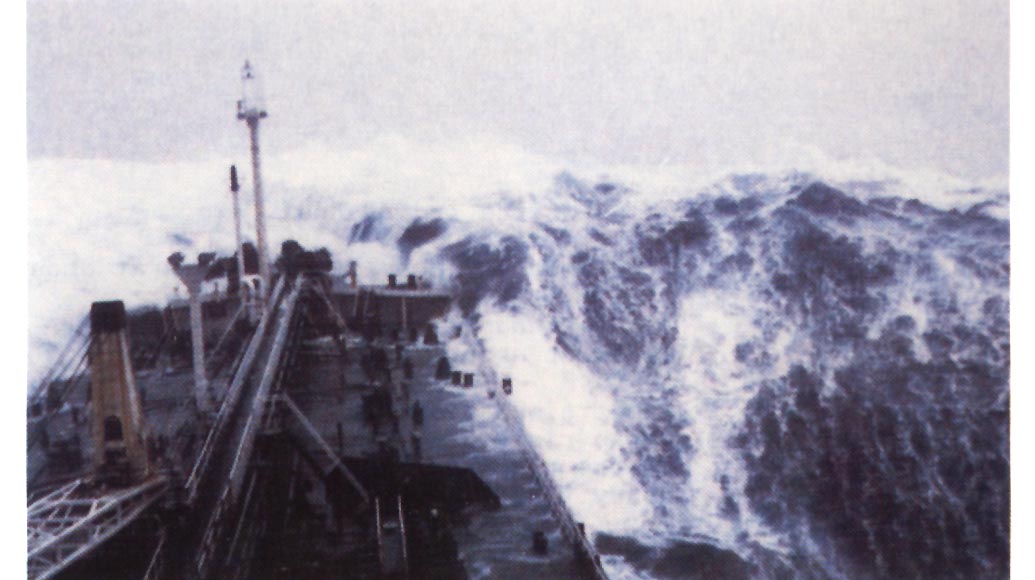
A storm blew up. It was not a light storm. This storm was a very intense low and the meteorologists later said it was an anomaly, a cyclonic low in the winter. The winds during the peak of the storm were measured on some of the ships at over 65 knots. The wave heights were in excess of fifty feet.

What fifty foot waves mean is that if you are on a navy ship smaller than an aircraft carrier, when you are standing in the pilot house and the ship goes down the back side of the wave and it is at the bottom of the trough, you cannot see over the top of the next wave. Then the wave crashes down on your ship and green water charges over the forecastle and up the front of the pilot house, covering the windows. The ship rides up the front of the wave and tilts over it. The bow comes completely out of the water and then slams back into the sea.

Ships with large sonar domes do not ride very well, for the sonar dome does not knife back into the sea. It slams down and the entire ship, all several thousand tons of it, shudders from the impact. Do that enough times and the sonar dome can be damaged.

Then there is the fun of being on a ship that is constantly rolling 40 degrees from side to side. Cooking is impossible, so you had better like cheese and bologna (“cheese and horse cock”)sandwiches, for that is all that there is to eat. And that will be your menu selection for three days, for on the fourth day, they’ve run out of bread.

“Cheese and horse cock, hold the bread.”

After the storm, the sailors have to clean the bulkheads along all of the passageways. Not because people have puked on them, but because they have walked on them. The lower portions of the passageways have footprints. The XO just loves seeing footprints on white bulkheads.

Sleeping is difficult at best. For the sailors on the bottom two racks, they sleep on “coffin racks”; the bunk is a mattress on top of a horizontal locker. The top rack is a mattress on a wire bed frame with springs around the edges. If you’re on a coffin rack, you hopefully have a bungee cord or three to secure yourself in. If you’re in a rack with a wire/spring frame, you sleep face down, for you then slip your arms under the mattress from either side and grab hold of the wire netting under the rack. And yes, you can sleep that way and you can learn to hold yourself in against the rolling of the ship without being thrown out or waking up.

There are things you try not to think about.

One is fuel oil.

Back in the day of oil-fired steam ships, which is to say, almost every navy ship that was not nuclear powered before the mid-1970s, fuel was kept in fuel oil storage tanks. Those tanks almost always had some water in them, because if the tanks were empty in heavy seas, they were ballasted down with seawater. The fuel was pumped to settling tanks, to allow the water to settle out. The water was stripped off, the clean fuel was pumped from the settling tanks to the service tanks, one pair for each boiler, and those service tanks fed the boilers’ burners. It was critical to keep water out of the fuel oil for, as you might suspect, water does not burn very well. At normal steaming rates, a service tank would last twelve hours or more before you had to switch them and refill the empty tank from the settling tanks.

In heavy seas, the settling tanks could not do their job properly, for the fuel would keep being stirred up and the water would not settle out. In really heavy seas, there almost was no point in using the settling tanks at all. You just hoped and prayed that the fuel going to the boilers was not so contaminated that the fires would be lost in the boilers.

For if fires were lost, the ship would go dead in the water, steerageway would be lost and in 50-foot seas, the ship would wind up not heading into the seas, but having them come from her beam. A warship the size of a destroyer or cruiser will not survive heavy beam seas for long, the sea will roll her over. And she, along with her crew, will die.

"Oh Lord, the sea is so vast. and my boat is so small."

Even a warship is a small boat in a Force 12 storm and fifty foot seas.

And you learn, as people in their twenties should, that sometimes your fate, whether you survive and thrive or die, is not up to you.

And you learn, as people should, that what is important to most landsmen really is not all that important. Whether or not your shoes go with your belt. The model of your car. Office politics. Who said what to whom. You learn that sometimes, all you can do is hang on, endure, and hope to survive. For if you do, you may come to know that what a lot of people on shore think is important is really just small stuff.

Saturday, June 7, 2008

Booze

You may have heard that Navy ships are dry, as in "no booze." That once was not the case. In 1914, during the height of the temperance movement, Josephus Daniels, the Secretary of the Navy in the Wilson Administration, issued a directive banning the consumption of wine, beer and hard liquor on Navy ships. (Back then, there was no Defense Department, the Department of the Army and the Department of the Navy were full cabinet-level departments.)

That order stood for a very long time. Wine was transported from time to time; you could buy cases of wine overseas and bring them back on the ship to be taken off when you got back (you could also do the same for some firearms), but on board, the wine was locked up as though it was plutonium. When ships from several NATO navies would have a pre-sail conference for an exercise, the conferences were never held on US ships, but always ashore or on another ship, so suitable libations could be served.

That started to break down in the late 1970s, as ships began to spend a lot of time in the Indian Ocean and the Persian Gulf with no great port visits. Ships that had not had a recreational port visit for more than thirty or sixty days were permitted to give everyone on board two cans of beer. The beer could not be consumed on the ship; if the ship pulled into a shithole like Djibouti, then beer was served on the pier. If not, sailors were loaded into the ship's boats, which motored around the ship while the sailors had their beers.

The beer was awful tasting swill. The rumor was that it was a special formulation of Budweiser that had formaldehyde added to keep it from going bad in hot conditions. It was, quite possibly, the worst tasting beer ever canned and if you have ever had Narragansett beer (a/k/a "Nasty Garrett"), you know that is saying something.

A second problem arose with the one of the collateral jobs of Navy warships. Navy warships visit foreign ports not just to give the sailors a place to get drunk and get laid, but to "show the flag." It is common for Navy ships to host receptions for local dignitaries. The problem was that the turnout for those receptions was not as good as the Navy would have liked, since everyone knew that there was no liquor served.

The Navy kept asking for an exemption from the ban for diplomatic purposes. By the mid 1980s, John Lehman was SecNav and he was sympathetic to the need to modify the ban.

So they did. Wine and port could be served at diplomatic functions, the ship's officers were allowed to drink during those functions, but only if they were not in the duty section.

One of the first functions where wine and port were served aboard a Navy ship was in Haifa, Israel. By a funny twist of fate, the ship that hosted the cocktail party was a guided missile cruiser, the USS Josephus Daniels. The function was indeed well attended.

After the function ended, the ship's officers assembled in the Wardroom, stood before the portrait of Josephus Daniels, and drank a toast to him.

Friday, June 6, 2008

Fire, Fire, Fire in Compartment.....

Of all the bad things that can happen at sea, probably nothing is more dreaded than a fire. Fire is what everyone trains for. Fire is why every sailor on every ship is required to complete a damage control qualification after reporting to each new ship.

Fire is why there is very little wood on a Navy ship. Other than a few decorative plaques, the only wood to be found on a modern Navy ship are the 4x4s used for shoring up damage and some plugs and wedges used for stopping leaks. This is a lesson that was learned with blood in the early days of World War II. You will not find a wooden ladder ("staircase" to you landlubbers) or wooden furniture. If you were to go into the Wardroom of a naval ship (the place where the officers eat and where the supply officers hang out), the furniture may look like they are made of wood and the bulkheads ("walls") may look as though they are wood, but it is all contact paper over metal.

The Navy is justifiably proud of its expertise in damage control. The rumor around the Fleet was that one of the reasons the HMS Sheffield was lost to an Argentinian Exocet missile was because the ship had wooden fixtures and ladders in parts of the ship and those items caught fire. The USS Stark was hit by two Iraqi Exocets. The one missile that hit the Sheffield did not detonate, while one of the Exocets that hit the Stark did explode. The USS Stark, after putting out the fires and stabilizing the damage, sailed away and eventually returned to the US under its own power.

There are a lot of factors that come into play, not the least being the prevailing weather and where the missiles struck, so the difference in the damage control readiness of the two ships may not be dispositive. The rumor was, however, that the British rapidly stripped their warships of wooden fixtures and furnishings.

If you look at a photo of a warship, you will see watertight hatches and doors. This photograph is from some civilian rustbucket:

Note the rubber gasket around the edge.

Now look at this photo (which is small):


The round door is called a "scuttle" and it is in the center of a larger hatch. You can see that there is a raised ring onto which the scuttle seats. That is called a "knife edge;" as you turn the locking wheel to tighten the scuttle down, the rubber gasket is mashed into the knife edge and that is what makes the closure watertight. If you now look back at the rustbucket's watertight door, you will see that the gasket is shot. It will be no more watertight than the average sieve.

Navy ships have a lot of watertight hatches and doors. It is the job of the Damage Control Petty Officer(s) (DCPO) in each division to maintain the WTHs and WTDs in the division's spaces. It is a pain to replace the gaskets, but the gaskets must be kept lubricated (with basically petroleum jelly) and replaced when they deteriorate. This is not rocket science, this is Damage Control 101.

At one point, I was invited to take a tour of a NATO warship. The ship was fairly new, was chock-a-block with weapon systems in a way that USN warships, which were designed to be able to remain at sea for much longer periods of time, were not. But as I walked around on the tour, I noticed that on every open watertight door and hatch, the gaskets were rotten. They were all shrunken, dried out and cracked. That warship had no watertight integrity and, in the event of a fire, it could not be made smoketight. The warship looked nice, it was clean and well-painted.

But it could not take a punch.

Damage control is the last line of defense against a loss of the ship. The USS Stark arguably seriously screwed up in its combat readiness, which is why she took two missile hits. But because her damage control was up to snuff, she survived and her crew came home.

The paramount importance of damage control readiness is a lesson the Navy learned the hard way. I doubt very much it has ever been forgotten.

Sunday, June 1, 2008

Supply

There is an old saying: "Amateurs concern themselves with tactics, professionals concern themselves with logistics." So let's look at logistics.

Every unit had three levels of supply priority open to them, which basically were "urgent," "priority" and "routine." The Navy's supply system had fifteen priority levels, numbered from one to fifteen. Which of any command in the Navy had what priority depended on what they did and where they were.

Nuclear-powered ballistic missile submarines, not surprisingly, had priorities one through three. A surface ship in home port might have a priority of five for the top level. A ship deployed might have a three for its top priority level. A ship in overhaul might have an eight for its top level. What this meant was that as far as the naval supply system was concerned, a case of toilet paper for a boomer had the same priority as a vital repair part for a deployed surface ship.

Every part in the Navy was assigned a naval stock number, or NSN. There were a shitload of digits in a NSN and there were massive catalogs on each ship listing them. Each department and division had manuals for every piece of gear that gave NSNs for the entire unit, for major assemblies, for sub-assemblies, right down to every screw, nut or bolt.

Supplies were in two basic categories: Consumables and repair parts. If you could solder or clip or insert or bolt something into a piece of gear or to the ship itself (and generally, if you could turn the used one back in), it was considered to be a repair part. Ships had budgets for repair parts, but the budgets for repair parts were generally flexible. If you needed a part to get underway or for a major piece of equipment, you got the part. A single "part" could be as small as a circuit card or as large as a towed array sonar (which came on a huge cable drum). Often, if you could turn the old one back in, you were charged only a small fraction of the cost of the part, as the turned-in parts were sent off for repair, refurbishment and reissue into the supply system.

Consumables were, as you might expect, everything from rags and paper to paint, grease and lube oil. Ships were given a budget and it was up to the Captain to divide it among the various departments. Since the consumable budget was a zero-sum game, it could get into bitter arguments between the department heads over who got what, and then at the the department level, between who got what.

There was never enough money for everything necessary. At one point, due to an accident on one ship, some genius came up with the idea that the engineering departments on ships should issue flame-retardant coveralls to everyone in Engineering who worked in the main plant. This idea didn't work for two reasons: First, the flame-retardant properties would not stand up to being laundered, so the coveralls soon became just heavy cotton coveralls. Second, and more importantly, the consumable budgets for the ships were not increased in order to issue two sets of coveralls to every engineer. So, for the most part, only the engineers who were in the fleet when the dictate was issued ever got one pair.

Food was a separate budget category
, all ships received the same amount of money to feed each sailor. (Officers were paid directly and then the officers, as a group, bought their own food.) Ships were free to augment that money, if they wanted (and some did), but of course, some other area of the consumable budget had to be cut.

The Navy operated on the Federal fiscal year of October 1st through September 30th. Like most large organizations, if anyone finished up a year with consumable money left over, you were not lauded for being a good manager. What happened was that "we obviously gave you too much last year" and your budget was cut. If you were into September and you had consumable funds left, you would go buy the "nice to have" items that you normally did without.

Money was not rolled over into the following fiscal year, either. The food on ships often became much better in September as the Supply Officer would buy fancier food items, such as good steaks and lobster tails, in order to use up the food budget. This was an area where ships that were "welded to the pier" because they were not in good shape made out like bandits, as good portions of their crew could be expected to eat some of their meals off the ship, while ships that spent most of their time underway fed almost everyone all of the time.

When you needed a part for a radar set or a tube of grease, you would write down the item description, its unit cost, its NSN and you would give it to the supply petty officer for your division. The supply petty officer would fill out a 1250 form, which was simple request for the thing you needed. The supply petty officer would take that form to the division officer or the department head for signature. The supply petty officer would then give the 1250 to the Supply Department, who would then type out a 1348 form for the requisitioned item. 1348s were little more than punch cards. If the ship was at sea, the 1348s would be compiled into lengthy teletype messages that were sent off by satellite UHF link. If the ship was in port, the 1348s would be taken to the Naval Supply Center on the base.

If the ship was in port, then every day or so, a truck would come by and drop stuff off. It was a whole different story if you were at sea, and that will be the subject of a later post

Sunday, May 25, 2008

The Fuze that Saved A Battle

In my last post, I mentioned the VT fuze. Before I get to the VT fuze and its importance, a short discussion of fuses is in order.

The earliest cannon projectiles were round shot. They were solid balls, first of stone, then of iron. Somewhere along the way, some enterprising person wondered if there was a way to combine the heavy throwing capability of a cannon with the blast effects of a hand grenade. Hand grenades, back then, were little more than containers packed with gunpowder. The grenadier would light a fuze on the grenade and throw it towards the enemy.

Obviously, stuffing a projectile with a lit fuze into a cannon barrel that has gunpowder at the other end is not a good idea. The early fuzes were little more than just that, the fuze would be lit by the combustion of the propellant charge, with the time to detonation determined by the length of the fuze. This had its drawbacks, so the impact fuze was developed. Depending on whether the shell was fuzed at the nose or at the base and how impact-resistant the fuze was, a projectile could be fuzed so that it detonated on impact or afterwards, to allow for penetration. Clockwork fuzes (also known as "mechanical timed fuzes") were also used to set projectiles to go off prior to impact, in order to spray shrapnel over a wide area. (In a throwback term to earlier days, setting a MT fuze is called "cutting the fuse").

This was about the state of fuze technology during the First World War. Still, fuzing was unreliable, I have seen estimates that a third of the shells fired on the Western Front did not detonate. As a result, the "Iron Harvest" continues to this day. Old shells, even from as far back as the Civil War, can still kill, as their fuzes have deteriorated and can be very unstable.

Timed fuzes were used against aircraft; the gunners would set the timers to go off at a set altitude. If the setting was wrong, the fuze would detonate the shell too high or too low. The Germans addressed this problem by having an airplane fly parallel to the Allied bomber formations and radio back the altitudes.

Timed fuzes were fine against level bombing attacks carried out at medium and high altitude, but they were useless against dive bombers. For a mechanical timed fuze to work. the gunner would have to estimate at what altitude the dive bomber would be when the shell reached the dive bomber, a near impossible task.

The answer was what was known as a "variable time fuze" or "VT fuze," which was a code name that did not reveal the true nature of the fuze, as every nation with antiaircraft artillery had timed fuzes. The VT fuze was a proximity fuze.

The VT fuze was a miniaturized radar set. That may sound like not so much of a big deal, but this was in the days before transistors had been invented. It was a huge advance to that point to have a radar set that was small enough to be installed in an airplane the size of a bomber. What the Navy's scientists and engineers had to do was develop a vacuum-tube range-only radar set that could not only fit in the fuze of a 5" shell, it would survive the massive G-force of being shot out of a cannon. And then, having solved all of those problems, they had to mass-produce them.

The only project that was deemed to be more critical than the development and production of the VT fuze was the development of the atomic bomb (a version of the VT fuze was used in the atomic bomb).

VT fuzes were used to shoot down Kamikazes and V-1 missiles. Without the VT fuze, the American death toll from Kamikazes would have been far higher. As it was, during the Battle of Okinawa, 34 ships were sunk, most by Kamikazes. The Navy had 5,000 sailors killed (the Army and Marines lost 8,000).

Whether the Kamikazes would have been able to cripple the Okinawa and Iwo Jima landing forces if the Navy did not have the VT fuze is a debate best left to the alternate history folks. But there is no doubt that VT fuzes saved thousands of American lives.

Saturday, May 17, 2008

Caliber and Other Musings

Naval rifles (what landlubbers refer to as "cannons") are traditionally designated by the diameter of their bores and by caliber. But in this instance, the "caliber" designation is nothing like civilian firearms.

Caliber, for a civilian (or Army) firearm, has some passing resemblance to the bore diameter. It varies, usually for marketing reasons. A .357 magnum can trace its bore diameter back through the .38 Special, the .38 Long, the .38 Short and all the way back to the .36 of the Colt Paterson revolver. A .30 rifle has a bore diameter of .308", a .303 has a bore diameter of .311". A 7.62mm rifle can have a bore diameter of .308" (NATO) 0r .311" (Russian). A .44 is really a .43 (.429"). And so on.

Caliber, for naval rifles, is the length of the bore from the breech to the muzzle divided by the diameter of the bore. The main guns of an Iowa-class battleship had a caliber of fifty, which meant that the length of the gun barrel itself was 800 inches (16"x 50); the designation of a 16" gun was a "16'/50". A common small-caliber gun in use up until the 1970s was a 3"50, which meant that the gun barrel was 150" long.

The 3" round was the largest one-piece round (known as "fixed ammunition"), in that the projectile was mated to the cartridge case. The 5" has a separate projectile, the cartridge case contains only the powder ("semi-fixed ammunition"). The old 8" and 16" guns used bagged powder, a method of powder handling that dated back to at least the 18th Century. The last versions of the 8" guns used powder in cartridges. So did the light-weight 8" gun project of the the 1970s, which was canceled thirty years ago.

The predominant medium caliber gun through World War II was the 5"/38. (When the projectiles were fitted with one of the technological wonders of the war, the VT fuse, the 5" guns wiped out most of the Kamikaze attacks. ) The ships built from the 1950s on were fitted with guns that had longer barrels: 5"/54s. The 5"/54 Mk.42 had provisions for local aiming with positions for one or two gunners. The Spruance-class destroyers were the first to be equipped with the Mk.45 5"/54, which eliminated the gunner's position. A new version of the Mk.45 that sports a 5"/62 gun is supposedly in use, which has higher chamber pressures and would have been able to throw a new rocket-assisted projectile (RAP) out to 60 miles.

When I first heard about this project, I was dubious. The Navy experimented with 5" RAP back in the late `60s and early `70s. RAP was renown for having two problems. One was at the extended range, you couldn't hit a damn thing with it. Second was when you added in the rocket parts, you were left with a something which was not a hell of a lot more powerful than a hand grenade, which made the RAP the world's most expensive grenade launcher.

So, to get around those problems, the idea became to basically throw a GPS-guided rocket out of a 5" gun. The projectile was going to be a lot longer and heavier than a standard 5" rounds, which of course meant that it would take up more space in the magazine and it would be much slower to load. Because the projectile being thrown out was a lot heavier than a standard round, the cartridge cases contained more powder. As any rifle wildcatter knows, more powder means higher chamber pressures and shorter bore life.

Apparently, it didn't work very well and the project has been recently shitcanned.

Thursday, May 15, 2008

Power Generation

There were several types of generators. Generators were classified by both type of service and by the type of prime mover which motivated the generators.

Ship's service generators were designed to provide electrical power to the ship during normal operations. The sizes that I saw ran from 500 Kilowatts to 1,500 Kw, with a voltage output of 440 volts. The motive power was either a steam turbine (a turbogenerator), a diesel or a gas turbine. Therefore you had SSTGs, SSDGs, and SSGTGs.

Emergency generators were fitted to some ships. These generators provided less power than a ship's service generator. They were either diesels or gas-turbines, as Solar gas turbines were fitted into the bows of some cruisers. Steam, for reasons that either are or will soon be obvious, was not used to power emergency generators. Therefore you had EDGs and EGTGs.

Some ships did not have emergency generators. The Knox class frigates had diesel generators that were of the same rated output as the SSTGs, they had one SSDG per ship.

Motor generators were driven by electrical motors. I wrote about LAPS here, the MG set which provided transmitter power to the SQS-26 sonar system. There were other MG sets, including one or more which provided 400Hz AC power for use in parts of the sonar and fire control systems. 400Hz power provided for much finer control than did standard 60Hz power; there were probably other reasons, which were explained to me in some boring electrical class and which I forgot as soon as I took the test.

Let's now consider the steaming of a Knox class FF and its electrical plant, which was about as simple a plant as there was. A Knox class ship had two boilers in one fireroom; one boiler was steamed for normal operations. Just forward of the Fireroom was Aux 1, which contained three SSTGs, each of which was rated for 750Kw. During normal steaming, two of the SSTGs would provide power to the switchboard in Electrical Central; the third SSTG would either be in standby or would be offline for routine maintenance.

Aux 2, which was well aft of the main plant, contained a SSDG and a separate switchboard. This was a very large unit, consisting of two V-16 GM diesels that drove the generator, and it was loud enough that double-hearing protection was required during operation. During normal steaming, the SSDG was offline and aligned for automatic start in the event that power was lost. Some ships would start the SSDG and bring it on-line for activities such as entering or leaving port or underway refueling; this ensured that if the plant failed for any reason, electrical power would not be lost at a time when having rudder control was vital. The SSDG was also aligned so that in port, if power was lost, the SSDG would start up (unless it was down for maintenance). If power was lost underway and the SSDG didn't start, you were shit out of luck.

If power was lost, whether underway or in port, the enginemen and the electricians would man up the SSDG and the After Switchboard. (In port, the electrician would immediately trip the breaker for the shore power lines, to prevent "feeding back" to the pier. ) Loss of electrical power underway meant that the boiler(s) had fires pulled, as there were numerous pumps in the main plant which were driven by electrical motors, including the condensate pumps, the main feed booster pumps and the fuel oil service pumps. Electrical devices throughout the ship were either on LVR or LVP switches. LVRs tripped off when there was low voltage and automatically came back on when there was enough voltage. Lighting and security systems were on LVR relays. LVPs were on items that were either not vital or that the power drain was such that it was not desirable for all that stuff to come on at the same time.

Underway or in port, loss of electrical power triggered an automatic security alert, where teams of sailors with guns would arm up and fan out about the ship to secure vital areas.

Underway, the boiler techs would work as fast as possible to get the boiler back on line. This was usually little more than use a periscope to look inside the firebox for spilled fuel and if none, start the light-off blower, get fuel recirculating through the lines and light fires. Once fires were lit, the boiler stops were opened, the SSTGs would start rolling over and as soon as the boiler was up to pressure, the SSTGs would be brought back on line and the main engine would start turning.

As the old saying went, for the screws to turn, the fires must burn, so Engineering was matter of "turning and burning."

Sunday, May 4, 2008

Navy Showers

You might have heard of a "navy shower." What you do is turn on the water, wet yourself down and then shut off the water. You soap yourself up, turn on the water, rinse yourself down, and you're done.

Navy ships do not have water to waste (and I will write about how fresh water is produced some other time). The standard for the use of potable water was 25 gallons a day for each person on the ship. So if you have a ship with 250 officers and sailors, that works out to 6,250 gallons of fresh water per day. That is not just for showering, that is for all uses: Cooking, washing pots and pans, laundry, showering, swabbing the decks, drinking, everything (except flushing toilets-- that was done with seawater).

Fresh water use is a critical item, for if a ship runs low on fresh water, then "water hours" are imposed. During water hours, the showers are secured except at designated times and, often, for designated people. The cooks get to shower, the sailors who got really filthy at work get to shower, but the "radar girls" up in CIC, the radiomen, and the sonar techs, among others, have to suck it up and do without.

So some genius at the Naval Sea Systems Command came up with the idea of a special low-flow hand-held shower head. The user would have to bring the nozzle up close to his or her body and then hold down a button on the shower head to spritz down their body. Needless to say, they were not popular. Some folks on the ships thought they were hazardous, as a sailor would have to rub down the rinsing area to make it work better, so that was one hand holding the nozzle, one hand rinsing off. That left no hands to grab onto the grab iron in each shower in the event of a severe roll of the ship.

Add to that the fact that some ships were pretty disciplined on water use and, unless there was an engineering casualty, had refilled their freshwater tanks by the beginning of the work day.

So we go now to one of those ships. The supply system had delivered enough of the new shower heads to refit every shower on the ship, with some left over for spares. The Chief Engineer ("Cheng"), who was intimately familiar with the ship's use of potable water, regarded those shower heads with the skepticism due any bright idea from the shore pukes. Cheng ordered the division officer whose sailors would install the nozzles to put them aside and to work on more important things, important being defined as "everything else."

The Supply Officer, who knew that the new shower nozzles had arrived, asked Cheng when they would be installed. Cheng politely advised the SuppO to "fuckin' mind yer own fuckin' business."

The XO soon found out that the new shower heads were on board. He asked Cheng if they had been installed. Cheng said no, that the sailors who would do the work were "busy." The XO caustically observed that if Engineering waited until they weren't busy to install the new shower heads, they'd never be installed. The XO ordered Cheng to "start installing those goddamned shower heads."

And so Cheng did. The shower heads were installed first in all of the showers in Officer Country, including the showers in the private heads of the Captain and the XO, and they were also installed in the head in the Goat Locker (the slang term for the "Chief Petty Officers' Quarters"). Cheng then sat back and waited.

The Captain advised the XO that the new shower heads "sucked." The XO, of course, knew that from personal observation. The junior officers grumbled audibly. But the biggest reaction came from the Goat Locker. The chiefs in B and M divisions knew what the fresh water usage of the ship was, they knew that the new shower heads were not needed. They made that point vocally to the other chiefs. The Command Master Chief relayed the complaints to the Captain and the XO.

And the chiefs had a plan. The R division chief ordered his sailors to reinstall the old shower heads and to "forget you ever saw the new shower heads." The sailors, who didn't want to have to use them themselves, were happy to comply. The chief storekeeper made sure that the supply records of the ship did not show that the new shower heads or any of the spare parts had ever been received.

And so, the next time that the ship went to sea, the R division chief threw the new shower heads over the side.

Problem solved.

Saturday, April 26, 2008

Bet You Didn't Know This

On every warship with a SQS-26 or -53 sonar, there were sailors who had to be medically qualified to be divers. They weren't divers, they had no training as divers, but they had to be medically qualified as though they were divers.

In an earlier post, there were pictures of one of those large sonars. The sonar domes had rubber windows on them, for tests had shown that a rubber window was a lot better at conducting acoustical signals than a steel dome was. "Better" means that you might track a target that you couldn't or detect a target that you might have missed. "Better" means that you kill a submarine, and that, Gentle Reader, is what it was all about.

What you had, therefore, was part of a very large rubber tire on the front and sides of the sonar dome. A cruiser or destroyer could push that very large sonar dome through the water at over thirty knots. To prevent the rubber window from being pushed in from that much force, the sonar dome was pressurized with water. Fresh water was used in order to prevent the corrosion that would have occurred from sea water. There were high and low alarm points on the pressurization system, the alarms rang in both Sonar Control and on the Bridge. The importance of keeping the sonar dome pressurized was such that the alarm box was placed right next to the Captain's chair on the Bridge.

In really heavy seas, the bow of the ship would come out of the water, sonar dome and all. When the bow came back down, that large sonar dome would slam into the sea; the entire ship would quiver from the force of the impact and then the bow would continue down until the ship started up the front of the next wave. Warships did best in heavy seas by sailing into the waves. (By 'heavy seas," I mean seas with wave heights of thirty feet or higher.) If you were on the Bridge while that was going on, you would hear the loud beeping of the alarm as the dome was slammed down into the sea, as that would briefly overpressurize the sonar dome.

It was sort of an informal gauge of how bad the seas were by the number of beeps you heard from the dome alarm each time the bow came back into the sea. It was not unheard-of for a ship to suffer enough damage to its sonar dome in really heavy seas that the ship would have to be drydocked for repairs. (I'll blog about that process another day.)

Back to the point: There were periodic checks that had to be done to the interior of the sonar dome. If a bad sonar transducer element was detected during a source level check, it might need to be replaced. The sonar was designed so that you could replace elements of the transducer without having to drydock the ship. But keep in mind that you have a large dome that is, at its base, over twenty feet under water. That is a lot of pressure on the rubber window. What was done was that the fresh water in the dome was pumped out and replaced with compressed air. There was an air lock in the access trunk to the sonar dome. (A "trunk" on a ship is a narrow vertical shaft that goes through one or more decks.) The sailors who would do the work inside the sonar dome had to have diver's physicals, since they would have to work in a pressurized area.

And that is why you had sailors who had to be medically qualified for diving duty on warships.

Tuesday, April 15, 2008

Dry Air

On something as complex as a warship, you can find things that hardly anyone has ever heard of, but are critical to the ship’s being able to do its mission. In that category were the air dehydrators. This is why:

For reasons probably understood by electrical engineers and physicists (of which I am neither), you cannot send radar signals from the transmitter to the antenna by a wire or a cable. You send the actual radar wave itself up a tube called a “waveguide,” which takes the signal from the transmitter to the antenna. The return signal also comes down the waveguide to the receiver. If you had a radio transmitter in your home, the waveguide is the equivalent to the cable running from the radio set to the antenna.

Radar signals are rather powerful, with air search radars having a lot more power than surface search radars. Fire control radars are the most powerful. There is a lot of energy going up those waveguides to the antennas. If there is any moisture inside the waveguides, there will be arcing and sparking inside the waveguides, which can burn holes in the waveguides and ruin them.

Ideally, the best thing to do would be to use an inert and dry gas to fill and pressurize the waveguides. That’s impractical on a ship, for the gas canisters would be another item that would have to be supplied to the ship. So what is done instead is to pressurize the waveguides with dry air.

By “dry air”, I mean really dry. The dryness of air is measured by dewpoint, the temperature at which the water in the air will condense out. You may know that when it is summer and the dewpoint is high, the air is muggy. In the winter, when the dewpoint is low, people complain about their sinuses drying out and many people use humidifiers. Those dewpoints are positively soggy and too high for a radar waveguide.

How dry? You need a dewpoint of probably around -40degF for a generic radar. For a high-powered radar, you need a dewpoint around -70degF or even lower. The dehydrators are operated and maintained by A-Gang and the dewpoint is measured with a special dewpoint tester that takes a sample from the supply line to the waveguides. If the dehydrators are out of spec, the radars are shut down and that makes the Captain very unhappy, especially if the ship’s mission is anti-air warfare. If the dewpoint tester breaks, the radars are shut down.

The damndest things are critical items.

Friday, April 4, 2008

Boomity, Boomity, Boomity

Everything you wanted to know about fire control (aiming the realllly big guns) but were afraid to ask. This was back in the days of gear-driven analog computers, nothing digital about this stuff.

Thursday, April 3, 2008

The Watch From Hell

One of the cardinal sins in the Navy is being outdoors without wearing a hat (Navy term- “cover”). The only exception is when something is going on that makes it unsafe to wear a cover, such as operating aircraft. If you go out on the weather decks, you wear a cover. The cover worn with the working uniform was a navy-blue ballcap with the ship’s name on it.

This story took place in Djibouti. Djibouti is in the horn of Africa, where the Red Sea and the Indian Ocean meet, a small flyspeck of a place neighbored by Ethiopia and Somalia and controlled, for all intents and purposes, by the French Foreign Legion. Both Somalia and Ethiopia at the time were more-or-less aligned with the Soviet Union, so Djibouti was the only friendly port within a long distance. Because Ethiopia and Somalia had simmering civil wars going on, Djibouti was full of people who were destitute. It was not a very nice or safe place to be. It was such a hardship post that when a Navy ship pulled in, the Americans at the local consulate would come on board and virtually strip the ship’s store of its stock of candybars, pre-recorded cassette tapes (this was in the pre-CD era) and other small consumer goods.

This story also took place in July. July in Djibouti was hot. The water in the harbor was well over 90degF. Ships air-condition their interior spaces with chilled-water heat-exchangers. The heat-exchangers use sea water to carry away the heat and when the sea water coming into the heat-exchangers is already hot, not a lot of extra heat can be carried away. So even though the interior of the ships were air-conditioned, those air-conditioners were barely keeping the ships cool.

So let’s set the Way-Back Machine to July in Djibouti, more than two decades ago. A Navy warship limped into Djibouti with a serious engineering problem. Parts and technicians had to be flown into Djibouti to fix the ship. The ship was there for at least two weeks at a time when no captain would have tarried in port for longer than it took to refuel and load supplies. The few crewmen who went ashore came back with stories of how bleak and nasty the city was. As a result, the ship’s company stayed on board and did things such as write letters home and catch up on their sleep.

The time is 1400 at the peak of the day’s heat. A young ensign, a graduate of the Naval Academy, was the OOD in port, also known as the Quarterdeck Watch Officer. From this young lad’s vantage point, you could see two French warships each the size of an American destroyer escort from the Second World War, a dumpster with a couple of emaciated dogs sleeping in the shade and one local man, wearing only a sarong, sharing the shade with the dogs. The man was there to sell t-shirts and souvenirs to the few sailors who were going ashore. The air was still, oppressively so.

A mess cook came up to the Quarterdeck with a dripping bag of garbage from the noon meal, which he intended to throw into the dumpster. He had forgotten his ballcap. The OOD didn’t want the mess cook to carry that dripping bag of garbage back down through the ship so the mess cook could get a cover, nor did he want to have the mss cook leave the bag of garbage on the Quarterdeck. So the OOD let him go off the ship to the dumpster sans cover.

That was when the Captain and the XO appeared on the Quarterdeck. They had a social engagement ashore. The Captain saw the bare-headed mess cook on the pier and promptly began to royally chew the ass of the unfortunate ensign with an obscenity-laced tirade. Peppered throughout the tirade were comments such as “hard to believe that you fucking graduated from the fucking Naval Academy.” The Captain ended his tirade with “you are on watch and you will remain on watch until my return.”

And so began the Watch From Hell. The other young officers on the ship took turns bringing him cool drinks. Every few hours, one of his roommates from the JO Locker (where the male junior officers slept) would bring him a fresh shirt, as the uniform of the day was Summer Whites. The OOD was relieved for the evening meal by the Chief Petty Officer who would have stood watch from 1600 to 2000, but other than that and a couple breaks to visit the head (bathroom), the ensign stood his watch. And the next one. And the next one.

The Captain and the XO, both of whom were three sheets to the wind, came back aboard around 0230 that night. When the Captain saw the ensign still standing his watch, he grunted “call your relief” and with that, the Captain stumbled off to his cabin. The ensign sent the messenger to get his relief (who was awake and reading a book in the Wardroom). The watch turnover took maybe 30 seconds and the ensign was on his way for a shower and some sleep.

Of all of the officers on that ship when this story happened, only that young ensign is still on active duty. He is a senior officer. I can only hope he has treated his young officers with more dignity and consideration than was shown to him.

But one cannot be sure, of course.