Thursday, June 4, 2009

The End of the Beginning

(N.B.: I posted this at my home blog. On further reflection, I should have posted it here, so I am cross-posting it.)
------------------------------------------------------
Today is the 67th anniversary of the Battle of Midway. The battle marked the turning point of the war against Japan. The Japanese sent a large force to invade Midway Island, spearheaded by four carriers. The US Navy had three carriers and, thanks to the Navy's code breakers, some knowledge of what the Japanese plan was.

The Japanese carriers launched strikes against the island, only to be found and attacked.


USN divebombers badly damaged three of the carriers on the morning of June 4th. All three were out of the fight, they were all abandoned and scuttled.


The fourth Japanese carrier struck back. Her planes badly damaged the USS Yorktown, which was later sunk by a Japanese submarine while under tow. This photo shows the Yorktown under attack.


The fourth Japanese carrier was sunk that afternoon.

Turning points to a war are only apparent long after they happen. At this point, the US and her allies in the Pacific had been at war with Japan for six months, the war would continue on for three more years.

The person who saw this most clearly, though, was Admiral Yamamoto, who, in 1940, was quoted as saying this about the prospect of a general war in the Pacific: "In the first six to twelve months of a war with the United States and Great Britain I will run wild and win victory upon victory. But then, if the war continues after that, I have no expectation of success."

He was right and he was proven to be so 67 years ago today.

Sunday, May 31, 2009

Anti-Air Warfare, Part 3

(Part 1 and 2)

Air defense in a battle group was controlled by the Anti-Air Warfare Commander (AW), known by the radio call sign "Alfa Whiskey". The officer who was Alfa Whisky was usually either the battle group commander himself or a member of his staff, but not always. If a guided missile cruiser impressed the battle group commander as having its shit together, then the cruiser's CO would be AW. In the former case, the battle group watch officer would be the AW watch officer. In the latter case, the cruiser's TAO would be the AW watch officer. AW controlled the entire air defense for the battle group, including the air-defense weaponry and sensors of all of the ships. The fighters assigned to Combat Air Patrol worked for AW, as did the E-2s. A ship could not disable any AAW sensor or weapon for maintenance without the permission of AW.

The key player in an air-defense situation was the Anti-Air Warfare Cooordinator, or AAWC. The AAWC sat at a NTDS-equipped scope. AAWC would designate targets by both NTS and by VHF unsecured radio, for when it got to that point, the need for speed overrode the need for security. How much the AAWC had to command depended on the warning condition.

There were three warning conditions: WARNING RED, WARNING YELLOW, and WARNING WHITE. They described the risk of an air attack on the battle group. (I never saw WARNING RED outside of an exercise scenario.) There were two weapons readiness conditions: WEAPONS TIGHT and WEAPONS FREE. They could be battle-group wide, assigned to one ship or CAP or even assigned to one ship and one radar track. Ships might be assigned certain compass arc within which they were WEAPONS FREE and outside of which they were WEAPONS TIGHT. Anti-air missiles were a very limited resource for any battle group; it was vitally important that there not be multiple ships shooting at the same target.

The overriding principle for command of the AAW battle was "control by negation." Within the parameters of the warning and weapons conditions, the ships and CAP could do what they wanted and if AW or the AAWC had a problem with that, they'd let you know. AW usually published guidelines determining which ship had radar picket duty if there was no E-2 coverage. Radar emissions control fell to AW.

The two primary air defense radars in the pre-AEGIS days were the SPS-40 and the SPS-48. The SPS-40 was a 2D radar (range and bearing information only), it was found on virtually every warship larger than a patrol boat. The SPS-48 was a 3D radar, it was found on virtually every ship capable of more than basic point defense. (By some quirk of the numbering system, the SPS-48 replaced the SPS-52.) Both radars scanned for range and bearing by mechanically rotating the antenna, the -48 electronically scanned for altitude (the antenna did not move vertically).

(All this, by the way, is pre-AEGIS.)

Friday, May 15, 2009

The Village People

Their music video was filmed aboard the USS Reasoner:


The song was a big hit in 1979, which is probably why the public affairs office cooperated with the record label and made a ship available to them for the staging of the video. Apparently the public affairs officers who approved the use of the Reasoner did not understand that the Village People were gay. But the Fleet did and the Reasoner was nicknamed "the USS Gay" (or worse) for years.

Tuesday, May 12, 2009

Uniform Disasters

One of the biggest disasters to hit the Navy in the 1970s was the change in uniforms. It was probably most severe on the junior and mid-grade enlisted (E-1 through E-6), but it was also not great for the officers.

There were two iconic uniforms from World War II to the 1970s for officers: Service Dress Khakis and Aviation Greens.


Service dress khakis gave officers a summer uniform that, at least for men, looked professional. Oh, they could wear service dress blue,

but that was kind of heavy weight and a solid black coat jacket and trousers in the summer heat were not enjoyable. Aviation greens were worn with brown shoes and were worn only by aircrew, which is why aviators to this day are known as "brown shoes" and surface officers are known as "black shoes."

Around 1975, aviation greens and service dress khaki were abolished. So was "summer blue" for women (a uniform authorized for both officers and enlisted).[1]


The two summer "non-working" (ie, industrial grade) uniforms left available for officers to wear in the summer were summer whites:

and service dress whites:

Both were 100% cotton. Service dress whites for men were known as "choker whites." One of the reasons was that they were worn primarily for formal occasions, the officers who had to wear them probably had bought them several years before. They were best worn when an adequate supply of blood to the brain was optional.

Service dress whites for female officers were styled like service dress blues:

Summer whites were hell to wear on a ship and they had to be worn for certain in-port watches. When the ship was making a port call overseas, besides the quarterdeck watch, the Command Duty Officer also had to wear whites during working hours. If the CDO was the Chief Engineer, you could be damn-near certain that he'd be royally pissed off by the end of the day as he had trashed his uniform when he went into the After Fireroom.

The Navy tried to adapt, slightly, by adopting a summer blue uniform that was nothing other than the summer white shirt and service dress blue trousers/skirt and shoes. It was known by everyone as the "salt and pepper uniform" and had been worn (probably still is) by the Public Health Service:

The salt-and-pepper uniform was roundly hated by the officers, as the nearly universal opinion was that it made naval officers look like pilots for some third-rate airline. It wasn't around for very long.

But the worst thing the Navy did in the early 1970s was to do away with the "crackerjack" uniform for its male sailors.

This was a photo of the then-outgoing blue crackerjacks and the new uniform for sailors:

The summer uniform changed little, as the non-crackerjack whites were in use.

The only change there was that the cover went from being the "dixie-cup" of the crackerjacks to the cover used by chiefs and officers. Chiefs and officers wore white shoes, petty officers and seamen wore black shoes.

The popular lore was that the abolition of the crackerjack uniform was a result of heavy lobbying by career First Class Petty Officers, who had gained weight and who looked like shit in crackerjacks. But it was a fucking disaster. Crackerjacks could be neatly rolled up and stored, but the coat-and-tie uniform had to be hung up. The cover (what you civilians call a "hat") also could not be crammed into a sea bag. Narrow coat lockers had to be fitted to every ship in the Navy.

Some of the changes came rapidly. Wear-testing of new crackerjacks began in the late 1970s and by the early to mid-1980s, the crackerjack uniform replaced the hated coat-and tie uniform for male sailors.

Service dress khaki is now making a comeback for chiefs and officers.

No word yet on whether aviation greens will ever return.

However, the Navy is engaged, now, in another uniform change that may be the subject of someone else's take on "uniform disasters" in 20 or 30 years.

From the 1940s (or earlier) into this decade, there were two working uniforms on ships. E-1 through E-6 wore dungaree blues:

1940s:

The dixie-cup cover was replaced with ballcaps in the 1970s. Each ship had its own ballcap.

Officers and chiefs wore khakis (really cheap-ass types bought them from Dickies). These are aviators, which is why some of them are wearing weirdly-colored shirts:

Sailors often referred to chiefs and officers as the "KKK" for "khaki-covered clowns."

The Navy is in the process of ditching the old-style working uniforms for new ones. The result of the change is that the Navy will look like a bunch of fucking jarheads. Battle Dress Oceanic[2] will be worn on ships. Why the Navy feels a need to adopt a camouflage-style uniform for shipboard wear makes little sense.


And, not having anything else to do, the Navy is also adopting enlisted uniforms that look as though they were ripped right out of the Marines' uniform shop.

The uniform disasters continue, so it seems.
______________________________________________
[1] As far as I can tell, trousers were not authorized with the summer blue uniform.
[2] My term for it. The Navy calls it the "Navy Working Uniform" or some shit like that. I reserve the right to laugh at every squid who is wearing it.

Monday, May 4, 2009

The Troll That Lived Under the Bridge

Traditionally, ships the size of destroyers and cruiser had two cabins for the Captain. One was a large cabin that had a nice bedroom, a sitting/dining room/office, a head with a shower, and a galley. This was known as the "in port cabin". The other cabin was a lot smaller; it had a bunk with a small closet and a tiny head. That was the "at-sea" cabin. The at-sea cabin was usually immediately behind the Bridge, the door often opened onto a passageway that had a ladder which went down to CIC. The Captain slept there when the ship was at sea so that he could quickly get to the Bridge. On ships with dial telephone systems, his phone rang in the at-sea cabin, the in-port cabin and next to his chair on the starboard forward corner of the Bridge.

That was not the case on the Knox class (1052) frigates. The Captain's cabin was forward of CIC, next to a four-man berthing compartment for very junior officers (the "JO Locker", later sometimes used for berthing female officers, as it had its own head) and under the Bridge. There was a voice tube that ran from the Captain's rack to just in front of the helm station. If the OOD blocked it with his head, what the Captain said was pretty secure.

The Captain's rack on a 1052 was strange. It was the only rack that folded up, like a top Pullman berth and when it did so, it converted into a couch. Every other rack on the ship was laid out on a fore-and-aft axis, so when the ship rolled, it was like being rocked. The Captain's rack was laid out athwartships, so when the ship rolled, the captain was pitched either with his head down or his feet down. It had to be very uncomfortable in any kind of heavy sea.

There were two ends of the spectrum of how captains led: The Coach and the Screamer. The Coach maintained a cool demeanor and when you screwed up, you felt more ashamed of letting the Coach down than you did about what you had done (or failed to do). A good coach inspired his crew to always do better, to strive for perfection, to be professional in all things.

The Screamer, on the other hand, ran his command by a reign of terror. A true screamer had no compunction about publicly humiliating anyone in his command, from the XO on down. His only tool was fear. The danger to the Screamer was that because his crew only feared him, they didn't respect him, and if someone saw a cost-free way to fuck him over, he would.

Serving about a ship captained by a screamer was like being in Hell, only without the smell of burning brimstone. You might have worked for a screamer in a civilian job, but at the end of the day, you got to go home. On a ship, especially a deployed ship, you were trapped. (The title of this post comes from the Knox-class, where a screamer captain would emerge from his cabin under the Bridge and verbally eviscerate someone.)

Paradoxically, screamers were good for re-enlistment statistics, as sailors would re-enlist early if they could get orders to another command. Officers did not have that option. I had a rule of thumb that if a first-tour junior officer spent more than a year on a ship with a screamer, you could forget about that officer ever going back to sea as a department head. If, on the other hand, that junior officer spent his or her first tour on a ship with a captain who acted as a coach and mentor, the young officer would probably be good for at least one more full sea tour.

I knew of one ship that had a coach of a captain; the ship and her crew just seemed to do everything effortlessly. Supposedly the captain would regularly tell his wardroom of young ensigns and JGs that "the rest of the navy is not like this ship." (Sad to say, he was probably right.)

This captain, on the other hand, was a screamer. There was one exercise in which that particular screamer, in a four hour watch cycle, kicked so many OODs off the Bridge by ordering each one to "call your relief", that the original OOD ended up finishing up his watch. It was really pitiful to see strong men quaking in fear of such a captain, for at sea, there was no escaping a screamer.

Real screamers could drive their XOs into full-blown alcoholism. The junior officers might amuse themselves by devising elaborate schemes to kill him. The sailors would try to figure out ways to torment him,if they did not go UA. It was like living though a toxic combination of the Caine Mutiny (without the mutiny) and Mister Roberts (without Henry Fonda).

There could be real camaraderie on a ship with a screamer, but it was borne of everyone sticking together in order to survive. On ships with sound-powered phone systems and screamer captains, it was not unheard of at sea for a sailor to wander by one of the deserted Quarterdeck stations, select the Captain's cabin on the station dial and then growl the shit out of the Captain's phone at 0300. The same trick was even easier on a dial-phone system, as the call could be placed from anywhere on the ship.

You might have a "Phantom Shitter", someone who would sneak into the Captain's cabin and take a dump on his desk. Smearing a thin film of black grease on the Captain's telephone to give him a black ear or on his binoculars to give him "raccoon eyes" was another trick. More evil was "dirty dicking" his coffee cup. Truly evil was coming up with enough dirt to warrant dropping a dime to the squadron or to a congressman, but that was inherently dangerous because if things were so bad as to warrant firing the captain, other people's heads would roll.

The change of command for a ship with a departing captain who was a screamer could be one for the books. It was not unheard of for, when the outgoing captain signaled that command had been handed over by saying "I stand relieved", the crew would start loudly cheering.

The unofficial motto of the Surface Warfare community was "We Eat Our Young" and the screamers were a manifestation of that. As long as the screamers delivered, as long as their ships got underway and met their commitments, the screamers were tolerated, but only up to a point. The few really vicious screamers that I knew of did not screen for a major command.

(Extra reading: The Arnheiter Affair)

Friday, May 1, 2009

AAW- a Detour to the Present Day

The threat of surface ships coming under attack by ballistic missiles which have maneuvering capability did not exist in my day.

But apparently, it does now
. Which explains why the Navy's concerns about ballistic missile defense extend well beyond what North Korea might do.

Friday, April 24, 2009

Fire Under the Sea

Aboard the USS Bonefish, 21 years ago today. Three men died that day.

Read here, here and here.

(H/T)

Anti-Air Warfare (AAW) Part 2

Part 1

This post will be about the Naval Tactical Data System, or NTDS.

NTDS as a concept is nearly 50 years old. The system transmits radar symbology among the ships in a task group. The original computers had a whopping 32Kb of core memory and they took up huge equipment spaces. They probably cost well over $500,000 in a day when an expensive new car cost $3,000.

In the `70s and `80s, the computers were replaced by AN/UYK-7s, computers that required air-conditioned spaces, water cooling of the equipment cabinets, special technicians to maintain them and were less capable than today's $500 desktop computer.

NTDS transmitted via radio (primarily UHF, I think) on three different data streams: Link 11, Link 14 and Link 4A.


NTDS enabled all ships in the task group to share contact and target data without voice comms.

Link 11 was a full two-way datalink. Link 11 ships both could originate the symbology and display it. The symbology was displayed on specially-equipped radar scope head. The symbols were a diamond shape (hostile), square (unknown) and circle (friendly). Full shapes were displayed for surface contacts, the upper half of the symbol was displayed for air contacts, the bottom half for subsurface contacts. Directional arrows were added, with varying lengths to give a graphic indication of speed. There was a numeric designation and additional data (course, speed, altitude or depth).

A Link 11 ship could be radar quiet, but because it was receiving Link 11 telemetry, all of this was displayed on the ship's NTDS scopes in CIC. The computers on each ship displayed things so that if no offset was selected, the display centered on the ship.

Aircraft carriers, cruisers, E-1/2s and long-range AAW shooters had Link 11 (CG-16/26, the few nuke cruisers, DDG-37s). Short-range AAW shooters (DDG-2s, FFG-1s) and ASW frigates generally had Link 14. Link 14 was not a computer link; the data was converted into teletype symbology. Sailors on Link 14 ships had to read the teletype data to other sailors standing behind transparent vertical plotting boards, just as they did in World War II. In a hot environment, Link 14 data was several minutes old by the time it was plotted and, for the purposes of AAW, it was all but useless.

Link 4A was a one-way datalink to older fighters, such as F-4s and F-8s. The symbology showed on their radar screens, enabling the controllers to designate targets to those aircraft without speaking over the voice link.

The F-14s' AWG-9 radar, while not capable of 360 degree coverage like the E-2, had a capability of detecting targets at long range. F-14s could and sometimes were used in a radar picket role; they were the first fighters equipped with Link 11.

Once things went really hot, then the voice comms came into use. That'll be the next topic in this series.

Thursday, April 16, 2009

Anti-Air Warfare (AAW)- Part 1

Defense of a task group is one of the newest warfare areas for naval forces. (Yes, I'm using the old term instead of the newer one "battle group". "Task" was good enough for Admirals Nimitz and Spruance, it's good enough for me.)

There are two guiding principles in AAW:

The first is "defense in depth." This means that there are multiple rings of defenses around the task group.

The second is "shoot the archer, not the arrow." If what the ships in a task group are doing is shooting at incoming missiles, then the defenses have already suffered a partial failure. The defensive ring around the task group should be far enough out to enable engaging (and killing) the missile-launching platforms. During the Cold War, killing the missile shooters spanned almost every area of warfare at sea: ASW to stop the cruise-missile submarines, anti-surface warfare (ASUW) to sink the missile carrying craft, which ranged from small patrol boats to large cruisers and even aircraft carriers.

Weapons and tactics are nice to talk about, but the most important thing is command, control and communications (C3). Without C3, the long-range weapons were useless. C3 in AAW was done by two lines of communication: the Naval Tactical Data System (NTDS) and voice radio.

Let's begin with look at the most important player in the AAW game: Airborne early warning radar. In the 1950s, the Navy used one airframe for ASW, AEW and for cargo-hauling, which was built by Grumman Iron Works. This is an E-1 Tracer. Tracers served the Navy for 20 years, until replaced by the E-2 Tracker. The Navy was very happy to get the E-1 and even happier to get the E-2, for retirement of the E-1 (as well as its sisters, the S-2 and the C-1) meant that the Navy also retired the use of aviation gasoline.


This is an E-2.


Airborne early-warning radar has two big advantages. First off, the detection range of an airborne radar is much further than that of a ship's radar, because the horizion is lot further away. Second, because the AEW radar is not overhead of the task group, detection and location of an AEW radar signal only tells the enemy that there is a task group somewhere out there, but it does not reveal the location.

But the information from the radar operators aboard the AEW aircraft has to be communicated, and that'll be the subject of an upcoming post.

Wednesday, April 1, 2009

The Ship's Store

Every ship had a ship's store and soda machines. The profits from those operations funded the Welfare and Recreation Fund. The ship's store was a counter-service operation on smaller ships and a walk-in store on larger ones. In the 1980s, cassette tapes, both blank and pre-recorded were big sellers. So was junk food, which the Navy called "geedunk," for reasons that nobody really knew. Personal service stuff, such as toothpaste, combs, shoe shine stuff, small uniform items (such as ship's ball caps and belt buckles) were among the items carried.

The biggest seller, back in the day, was cigarettes. When the ship was out in international waters, the sales were tax-free, and the cigarettes were known as "sea smokes". They were cheap. Really cheap. As in twenty-five cents a pack or two-fifty for a carton. Even in port, the sales were free of state taxes. Normally that was not a big deal for East Coast ships, as states such as South Carolina or Virginia did not have high state taxes on cigarettes.

Wise supply officers would overstock the ship's store prior to visits to some lesser-developed nations. Privileges to use the ship's store were extended to personnel at the local US embassy or consulate; they sometimes descended on the ship's store like a cloud of locusts. That made the supply officer and the XO very happy (the XO ran the Welfare & Rec committee), but it tended to piss off the ship's company.

A real fight sometimes ensued when ships were in overhaul. Shipyards all had canteens and/or "roach coaches"; cigarettes were a major part of their sales. Some ship's captains recognized that it was in their best interest to make it possible for the yard workers, known as "sand crabs" or "yard birds", to be able to buy sodas from the machines as well as smokes and geedunk from the ships' stores. First off, it reduced the time that the yardbirds took on breaks, so more work was done. Second, it really boosted the profits to the Welfare & Rec Fund. Some ships put soda vending machines right next to the Quarterdeck so all of the yard birds would know where the machines were.

That pissed off the canteen operators, especially in the Northern shipyards. They had to charge state tobacco taxes, so their cigarette sales took a serious beating. At least one shipyard complained to the local state tobacco authorities, who, knowing they did not have jurisdiction over Navy commissioned warships, referred the matter to the Naval Investigative Service (NIS). The NIS would send an agent or two to try and "talk sense" into the Commanding Officer and ask that sales of cigarettes and geedunk be restricted to ship's company only.

Many COs complied. More than a few, though, asked the "well, what if I don't" question. The answer was that if the civilian cops found a yard bird with a pack of untaxed cigarettes, they could arrest him, but there was nothing that could be done to the CO. The COs then would agree to only sell one pack of smokes at a time to the yard birds and that was the end of the matter.

Wednesday, March 18, 2009

Time Ball

I was on shore duty for a spell and, from time to time, I had to travel on the government's business (and on their dime). That almost always involved renting the cheapest econobox that the rental company the government used had on the lot. If my memory is correct, the cars were from National and the cars were Corollas.

On one trip, when I picked up the car, the rental agent gave me a freebie, a little travel alarm clock that was called a "time ball" which was about the size of a golf ball, maybe a little bit larger, with a digital display. It was pretty handy to have on that trip.

After I returned to my duty station, I filed my trip report and my receipts for reimbursement. (They'd give me the airline tickets, but I had to pay for everything else and then file for reimbursement.) A few days later, I got a phone call from the travel department. They wanted to know if I had gotten any freebies from the rental car company. I told them I did. They told me to sent it over, since the government paid for the car, the clock belonged to the government.

I could see the logic of that. What I could also see was that the clock would be taken by one of the weenies in the travel department.

I took an interoffice envelope home with me. When I got home, I picked up the clock and I realized that, because of its round shape, it wouldn't fit very well in the envelope. So I put the clock in the envelope, put the envelope between two boards, and applied some percussive adjustment. It fit a lot better. The next morning, I dropped it into the interoffice mail.

The next day I got another call from from the travel department. They wanted to know what happened to the clock. I asked what was wrong with it. They said it was smashed to bits. I said: "I don't know what to tell you, it was fine when I put it in the envelope."

After that, I refused all of the freebies.

Wednesday, February 18, 2009

Career-Limiting Move; Pt.3

As promised. Some folks will be lucky if losing their career is all that happens to them.

Tuesday, February 17, 2009

Career-Limiting Move; pt 2

I am trying to develop some sources on the grounding of the USS Port Royal. If I do, check over at my main blog. I am going to try and not cover current events in this blog; as much as possible, I'm going to stick to the navy of the 1980s.

Thursday, February 12, 2009

A Career-Limiting Move

Running your ship aground. According to this story, the USS Port Royal went aground in "about 20 feet of water."

The Tico cruisers draw about 34 feet of water
, so depending on the slope of the bottom, something seriously went wrong. I can't imagine that the charts around Pearl Harbor are inaccurate, so it seems that somebody lost the bubble on the navigation picture. Executive Officers were designated as the ship's navigator, so the XO's career is toast, as is the career of the OOD (probably the only one who doesn't have enough time in to gracefuly retire).

Running aground is almost always career suicide. There was a real up-and-coming officer in the late `70s and early `80s; he deep-selected for both lieutenant commander and commander. Less than two months into his command tour on a Spru-can, the ship ran aground while on an in-shore acoustics range somewhere off Florida. Rumor was that he said something along the lines of "XO, I think we're turning the wrong way" just before the ship grounded. That was the end of his career.

I worked on one grounding investigation of a smallish research craft commanded by a lieutenant and the result was the same, as it almost always is. Unlike rivers, much of the ocean bottom doesn't move that much and unless either the chart is wrong or there was an unavoidable event, touching bottom means the captain and a bunch of other folks get sent ashore for good.

Tuesday, February 3, 2009

Monday, February 2, 2009

The Flesh-Peddlers

Most civilians seem to think that the military assignment system works this was: One day, you just receive a set of orders to go someplace. And you go.

Not exactly.

The overall principle was "the needs of the Navy." Within that, there is a whole lot of wriggle room.

The assignment process was basically run by two groups of people: Assignment officers and detailers. Assignment officers represented the commands, such as small combatants, cruisers, squadron command staffing, bases, and all that. Detailers represented the people being assigned, by warfare community; there were surface detailers, sub detailers, aviation detailers, and so on. The detailer's job was to get his or her clientele the best possible and most career-enhancing jobs they can. The assignment officers worked to get their clientele, the commands, the best people. So it roughly worked that the best people went to the best jobs. Assignment officers and detailers were collectively referred to as "the flesh-peddlers," which was as good a sumation of what they did as any, I suppose.

This worked out really well for sea assignments, but not so well for shore duty. Line officers who went ashore often were more concerned with geography than what they did, for they know that unless they really screwed the pooch, what they did ashore mattered little.

Every so often, the detailers would travel to the western Pacific and the Mediterranean to meet with the junior officers on the ships. They would meet with all of the officers for individual counseling sessions; they had cards with them which summarized each officer's present assignments, past assignments and the numerical scores from their fitness reports.

So one fine day, a team of two surface detailers was on a ship that was visiting a French port. (It was kind of interesting how the detailers seemed to pick the best ports for their visits.) They had posted a signup sheet with all of the officers' names so they could sign up for appointments. At lunch that day, a lieutenant asked one of the detailers why his name wasn't on the signup ship. The detailers asked his name, which was David Jones. The two detailers were flipping through their cards, first slowly, then frantically, as LT Jones was complaining that he had been on the ship for five years (the normal length of a first sea tour was three years) and that he never got any responses to his letters to BuPers and his calls were never returned.

The two detailers were showing visible signs of panic when the Captain took pity on them and told them that Jones was a LAMPS helo pilot (he had borrowed a SWO pin). The detailers were too relieved to be mad and one of them said: "You know, this has happened before."

The detailers really did try to get the best jobs for their people, as being a flesh-peddler was very good for one's career. Flesh-peddlers pretty much got to write their own next set of orders and the goal was to, on the next shore duty assignment, come back as a more senior flesh-peddler. If your clientele complained a lot, you weren't going to be invited to come back.

The maddest I ever heard of them getting was at one Destroyer School class. Each class had fifty officers in it. When it came time to bid for assignments, the bidding was by ship type, job type and home port; you ranked each in order of priority. And, as it turned out, of the fifty officers in that class, thirty two or so put down that their number one choice was to be the operations officer on a Spruance class destroyer with a home port of Norfolk, VA.

There was one billet open for an operations officer on a Norva Spru-can. Which meant that over 30 officers were not going to get their first choice. And that had a factor in how well the detailers were rated on their jobs. So they were extremely unhappy.

Not that anybody gave a shit.

Tuesday, January 27, 2009

Selection Boards

The Navy was big on selection boards. They all operated out of BuPers and they all served the same function: To screen the records of candidates for schools or promotion. The criteria depends on the times.

All officer promotions, other than to lieutenant (junior grade), were screened by a selection board. Selection to LTJG was almost automatic.[1] Selection to lieutenant was nearly automatic, but each year, there were a few JGs who were so hapless as to not warrant selection to LT. If you failed to select to LT, they would look at you the following year, but good luck with that, and you were let go.

Selection was done on the basis of the "year group" of the officers, which was the fiscal year of commissioning. If you were commissioned in fiscal year 1982, you were in Year Group 82.

It worked like this: Say you were in YG 82. The Navy determined what would be the normal point of selection to LCDR, which generally would have been eight years after commissioning. (This was adjustable for different designators; some might select a year earlier, some might select later.) Say that you were a LT in YG 82 and you were due for regular screening by the LCDR selection board in `90. You would first be screened in `89 for "deep selection." Deep selection was basically a free bite at the apple; if you were not selected, it didn't hurt you. Deep selection was available to real superstars and if you were "deep-screened," it was a sign that you were on your way to a storied career, provided you didn't fuck up.[2]

Promotions were effective at the beginning of the fiscal year after selection in order of seniority. The OCS grads who were commissioned early in the year went first, then the big bulge of ROTC and Boat Skool grads, followed by the last OCS classes. (OCS back then had about seven classes a year.)

The next year you would be screened for regular selection. This was the make-or-break point. If you didn't screen for LCDR, your career was on hold. The selection board would look at you again next year, to see if your subsequent fitness report showed that you had gotten your shit together, but late selection was a rarity and was more a sign that the earlier selection board had made a mistake. That was the principal reason for late selection, to catch mistakes made by the selection board in the previous year. (I believe that it was not permitted to be a member of two successive selection boards.) If you failed to late-select for LCDR, you were separated from the naval service (though nowadays, you could cross-deck to the Army and go get your ass shot at).

Prior to the 1990s, promotion to LCDR meant that you were guaranteed your 20 years in for retirement. If you then selected for commander (CDR), you had 23-25 years guaranteed and for captain (CAPT), 25-30 years. The funnel got narrower each step along and it really tightened down for selection to commodore, er, excuse me, "rear admiral lower half."

The surface navy had three other major selection boards. The first was for selection for Department Head, which was commonly called "Destroyer School." This board screened people well before the LCDR selection board. If you failed to select for Destroyer School, you didn't select for LCDR. If you were in Destroyer School and you didn't select for LCDR, they pulled you out of the school right then and there and it was so fast that you'd have thought that Stalin had ordered you purged (I knew of someone who had that happen.)

In the 1970s, selection for Destroyer School was damn near automatic. In the early 1980s, they had so many people backed up in the pipeline for the school that nobody would have made it through the school prior to their regular screening for LCDR. As the Navy generally preferred to have one fitrep as a department head in each officer's record prior to LCDR selection, they rescreened the pool and got rid of a lot of people. Those who were bilged out were told that they would never select for LCDR and they might as well go home sooner, rather than later, and many did.

Screening for XO was done after the department head tours. If you didn't screen for XO, you didn't make CDR. Sometime in the 1980s, the rules were changed so that to screen for XO, you had to have taken both the written and oral test for command-at-sea. And, as you might imagine, if you didn't screen for CO of what was known as a "commander command," you didn't make CAPT.

There were selection boards that operated pretty much below the radar. Two of those were selection to the Naval Postgraduate School and selection to attend the Naval War College. You didn't find out that you were up for them or if you weren't selected, only if you were selected. The Navy formed an engineer designator in the 1980s to keep talented ship's engineers who were not screening for XO or CO, this selection board also operated unseen (unless they chose you).

Supposedly they all operated the same: There were a bunch of senior officers who did the screening and one who operated as the recorder/secretary. They'd pop the records up on a screen, which was easy to do as BuPers kept all records on microfiche cards, and make a decision. Close calls might be set aside for further debate, but for most, pass or fail was done in a matter of minutes, if that long, by near unanimous votes of the selection board.

[1]It took fucking up on a level of "done fucked the Admiral's dog and run over his daughter" kind to not get promoted to `JG.
[2]If I remember correctly, there was one guy who deep-selected to both LCDR and CDR. Six weeks or so into his command tour on a Sprucan, the ship ran around off the acoustic range off Fort Lauderdale. That was the end of his career (I've forgotten both his name and the ship).

Sunday, January 25, 2009

Corrosion Control

Salt spray and aircraft aluminum do not mix very well. It is going to take a lot of fresh water to clean up that helicopter.


Giant Waves on Aircraft Carrier - Watch more Military Videos

The Chief Engineer is not going to be very happy.

Monday, January 19, 2009

Evaluations and Fitness Reports

Officers received fitness reports ("fitreps"), enlisted men and women received evaluations ("evals").

There were some similarities between the two. Ensigns and `JGs (lieutenants junior grade) received fitreps every six months, as did sailors who were third class petty officers or lower (E-4 and below). The early promotions came sooner and it was important for junior officers and sailors to build up a track record. Everyone else was evaluated on a yearly basis or when they were transferred to another command.

Evals and fitreps were both originated by the immediate supervisor, which is to say that the division chief wrote the first draft on evals and the department heads wrote the first draft on division officers. Eval grades were 4.0, 3.8, 3.6, 3.2, though once it got down below 3.0, I think the intervals got larger. Fitreps grades were top 1% top 5%, top 10%, top 30% top 50%, Bottom 50%, bottom 30%, bottom 10%. I didn't recall if they went lower than that, they could have. E-4 and below evals could be signed by a lieutenant commander. On cruisers, that usually meant that the department head could (and did) sign them. On frigates, where the department heads were typically lieutenants, the XO signed them. E-5 and above evals and fitreps were signed by the CO. The Captain signed all fitness reports.

To say that these were important is sort of like saying that the Sun provides useful heat to the Earth.

For sailors, there was a bit of a cushion, as up though PO1 (E-6), the selection for promotion was statistical-- the Navy promoted the top sailors in each rate (defined in this post) as determined by evaluation scores and by scores at rate schools and the required correspondence courses, so it was possible, by killing the schools and courses, to get a little bit of an edge. Sailors generally were not screened by a selection board until they were up for selection for chief petty officer.

For officers, it was all about fitreps. As long as one got through the schools, that was all that counted there.

First of all, the grades mattered. Fitreps and evals were done on scannable forms back as far as the mid 1970s and maybe earlier. The grades were X'd into blocks on the form, with "top 1%" and 4.0 indicated on the far left of the grading row. If you were receiving one and if you were ambitious, you wanted one that was "fully left-justified."

The next thing the CO had to do, and probably the hardest, was to rank his officers. If he had six ensigns, somebody had to be 6 of 6. If you were a middling officer in a wardroom loaded with outstanding performers, your career was in trouble. While BuPers{1} had the ability back then to use the computers to sort officers by grading, they did not have the ability to sort them by rankings within a command. So if a CO had three outstanding JGs on his ship, he'd sometimes rank all three of them "1 of X" and just hope that when the fitreps were reviewed by the selection boards, that nobody would catch that.

Then came the written evaluation. This was were the CO justified his grading and his ranking. The written evaluation portion was vital, as this was where the selection boards made adjustments for the grading. An officer who might have had a third-rate job and scored top 1% would not be regarded as well as an officer who had a really tough job and scored top 5% or even top 10%.

Awards also mattered back when both the Navy (and even more so, the Marines) had a reputation for not handing out medals and awards like Halloween candy. It was a point of real awe to say, about a naval officer, that "he has as many ribbons as an Air Force major."

Fitreps obviously mattered for promotion, but they mattered for assignments. The better the fitrep, the better the next job. Good fitreps meant that one got to advanced schools such as the Naval Postgraduate School or the Naval War College. Mediocre fiteps meant that one was sent to jobs nobody wanted.

Selection boards and the assignment process will be another topic.

{1} (BuPers stood for the Bureau of Personnel, which was renamed the "Naval Military Personnel Command" (NMPC) decades ago and then they dropped "Military" to make it the NPC, but almost everyone still refers to it as BuPers.)

Sunday, December 28, 2008

ASW Weapons, the Conclusion

(Parts One, Two and Three)

The SQS-23 and other Korean-War era sonars, as I mentioned in Part 3, had the capability to detect and track submarines far outside the range of Hedgehog. The US Navy, among others, experimented with larger spigot mortars and rocket-thrown depth charges. Weapon Alpha was one that was largely unsuccessful.

All such weapons had the same problems; there was an unsatisfactory dwell time between the time the rocket was fired and the time the depth charge had sunk to the correct depth and detonated. All of those were predicated on the somewhat ludicrous idea that a submarine commander, knowing that he was being tracked by a destroyer, would hold a steady course and speed.

The answer was ASROC, for "antisubmarine rocket."
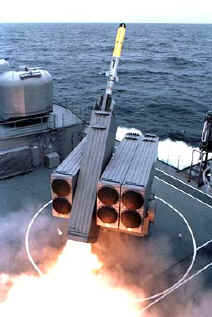
As you can see here, ASROC was a rocket which was fired from an eight-cell box launcher. The launcher itself used recycled deck mounts from 3"/50 guns. The rocket itself was a dumb, ballistic, solid-fueled rocket motor. Aiming was done by training the launcher and elevating the two-cell box with the ASROC to be fired. It worked out to be far more accurate than you might think.

On ships with Terrier (later, SM-1/2 ER) launchers (the DDG-37s, CG-16s and CG-26 class ships), ASROC was fired from the missile launcher. Each ASROC loaded was one less Terrier that could be carried. As the main mission of those ships was anti-air warfare, ASROC and ASW were the bastard stepchildren.

The business end of ASROC started out as a Mk.44 torpedo:


The Mk.44s proved to be unsatisfactory (among other things, it was slow) and were fairly rapidly replaced by the Mk.46. The torpedoes were active homers; they had a very high frequency sonar set. For guided weapons, they were the first true "fire and forget" weapons of the surface navy.

For close-in work, the torpedoes were also fired from deck-mounted launchers. Triple-mounts were added to a lot of ships:


The Knox class had twin mounts on either side of the after deckhouse, which were built into the deckhouse just forward of the LAMPS hangar.

ASROC also had a nuclear depth charge variant. This was the only live test, fired in 1962, before the Atmospheric Test Ban Treaty came into effect:


The nuclear ASROC worked like an old rocket-thrown depth charge, but with a hell of a bigger bang. The dumb-rocket version of ASROC left the fleet in the early 1990s when the ships with SM-1/2 ER or box launchers were all retired. A vertical-launch ASROC was eventually developed for use in current warships, though it reportedly was a pretty troubled development program.

ASROC could reach out several miles. But once again, the sensors outranged the weapons. The SQS-26 sonar, through either "bottom bounce" or "convergence zone" modes, could detect and track submarines way the hell out. The first solution was the Drone Anti-Submarine Helicopter, or DASH.
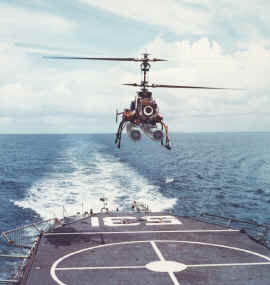
The concept of operation of DASH was simple: Fly the thing out until the markers from the sonar operator tracking the submarine and from the radar operator tracking the DASH converged, then drop the torpedo. Repeat if necessary (later models of DASH carried two torpedoes), then fly back to the ship for more fuel and torpedoes.

In practice, DASH didn't work so well. The drones were legendary for crashing and the DASH program was axed.

But that still left the problem that ships could track submarines further out than they could attack them. The answer was to provide ships with manned helicopters, the Kaman Seasprite, SH-2F LAMPS Mk 1:

LAMPS stood for "Light Airborne Multi-Purpose System," though a lot of sailors referred to it as "Lousy Air Mail and Passenger Service," for the best thing that the helo could for morale was to go get the mail from the carrier. The two drop-tanks you can see on this helo could be replaced by Mk. 44 or Mk. 46 torpedoes, though taking off a drop-tank reduced the in-flight endurance by 30 minutes. The red/white hashmarks outline the location of the sonobuoy launcher.

Late in the 1980s, LAMPS Mk.1 was replaced on the Spruance and Perry class warships by LAMPS Mk.3, which flew the SH-60F. The SH-60 program was supposedly the first aircraft procurement program where the prime contractor was not the airframe manufacturer (Sikorsky), but the electronics package manufacturer (IBM). Those ships were supposed to be able to hold two SH-60s. I never saw more than one LAMPS on a ship at a time and I think I maybe saw one SH-60s.

LAMPS would go out to the location of the submarine as determined by the active sonar track and stream a towed bird that contained a magnetic anomaly detector, the "MAD Bird." There were several different patterns the helo could fly to develop a track on a submarine; once the helo tracked it, it could drop a torpedo.

LAMPS also required a lot of people. The air detachment for LAMPS had three or four pilots and about 20+ sailors, with the senior officer being the head of the Air Department. More than one ensign or JG division officer in the other departments had more sailors and equipment to maintain than those four officers in LAMPS, which lead to the standard complaint of: "I know what they do to earn their flight pay, but what do they do to earn their base pay?" The corrosion control program for the helos required that they be frequently washed with fresh water (the fresh water usage of the LAMPS detachment routinely led to the Chief Engineer threatening violence upon the Air Boss).

LAMPS pilots were certifiable. Take a look at the photo of this Knox-class FF and note the size of the flight deck:


Now imagine trying to land a helicopter on that deck, at night, with the wind burbling around the superstructure and the ship rolling a bit. The LAMPS pilots did that, and the flight deck on a Garcia class FF was even smaller. They had to be nuttier than a jar of Planter's.

LAMPS became even more important when surface ships began to be fitted with towed array passive sonars (TACTASS, for Tactical Towed-Array Sonar System). If conditions were right, a towed array could be towed below the thermocline layer, down where submarines could hide from the hull-mounted sonars of ships. LAMPS were fitted with a launcher that fired off sonobuoys; little floats that dropped hydrophones deep into the water. The buoys had radio transmitters that send the signals to the LAMPS helo, which relayed them to the ship's sonar shack, where the signals were printed out on a frequency analyzer that was surplused from the P-3C upgrade program.

Sonobuoys came in several flavors. The ships had to pay for them and, as the ones with dumb omnidirectional hydrophones were the cheapest, those were the one used the most. There were sonobuoys with active pingers, but they were both costly and, as they alerted a sub that it was being hunted, not preferred.

Sonobuoys were used to localize a contact gained from the towed array. Once the contact was localized, the LAMPS helo would be vectored in for a MAD search. Once the helo had a MAD contact, then it was up to the three crewmen in the helo (two pilots and a sensor operator) to gain an attack solution and kill the submarine.

Friday, December 19, 2008

The Big Ensigns

This is an official photo of a Navy Rear Admiral (lower half):


His paygrade is O-7 (1 star), the equivalent rank in the Army is Brigadier General.

This is an official photo of a Navy Rear Admiral (upper half):


His paygrade is O-8 (2 stars), the equivalent Army rank is Major General.

In practice, the terms "upper half" and "lower half" are dropped.

Now you might be thinking of asking this question: "Comrade Misfit, why do two different naval ranks use the same title?"

Good question, and of course, there is a story behind that.

Historically, 1-star officers in the Navy had the rank of "Commodore." ("Commodore" is also the title of an officer who commands a squadron of ships, but that's not important right now.) For a long time, the Navy did not have 1-star officers; the rank was activated only when there were large wartime fleets. Officers who were promoted from paygrade O-6 to O-7 would don the uniform and insignia of a O-8. "Upper half" and "lower half" were used only for seniority and pay purposes.

What this meant was that on the day when a Captain was promoted to Rear Admiral, he would go into work wearing the uniform of an O-6 and go home wearing the uniform of an O-8.

As you might imagine, that griped the living shit out of the generals in the Army, Marine Corps and, most of all, the Junior Birdmen. The one-star generals in joint commands really hated the fact that they would go from being called "sir" by a naval Captain to having to salute the same guy after his promotion. They resented the hell out of that and complained to the Navy for decades. The Navy, of course, didn't give a flying fuck what the other services thought and regarded the offended brigadier generals as a bunch of crybabies.

In 1980, a bill came up to Congress to require the same treatment of officers by all of the services. The bill, the Defense Officers Personnel Management Act, or "DOPMA," forced the Navy to resurrect the one-star rank, beginning in 1982. Which the Navy did. The Captains who were promoted that year were duly promoted to the resurrected rank of Commodore; they wore one broad stripe on their dress blues.

And in short order, the whining came from the Commodores. The abbreviation for Commodore was "COMO." The Commodores complained that their mail ws being misrouted to the Officers Club (formally known as the "Commissioned Officers Mess, Open, or "COM,O") or to the base communications officer ("COMMO"). The biggest insult came when a four-star Army general, in discussing the replacement naval officer to be assigned to his staff, told the Navy to "send me a real admiral, not one of those weenie commodes."

The whining of the Commodores was written up in the Navy Times newspaper and, in the letters to follow, the junior officers and the enlisted men had a lot of fun at the expense of the Commodores. Most of the letter-writers more or less advised the Commodores to suck it up. One suggested that the ranks of Rear Admiral and Commodore be renamed to "Front Admiral" and "Rear Admiral," respectively, and that the proper halves of a horse costume be issued to those officers. Another published letter noted that Ensigns (pay grade O-1, also sometimes referred to as "enswines" or "butter bars" and equivalent in rank to an Army 2nd lieutenant) also wear a single stripe on their dress uniforms:

and suggested that Commodores be referred to as "Big Ensigns."

The Commodores were, of course, even less amused by the fact that now the rest of the Navy was poking fun at them. More than a couple Commodores had the experience of having junior officers both salute and laugh at them at the same time.

And so, after a decent interval of time, the rank of Commodore became the rank of Rear Admiral.

Wednesday, December 17, 2008

The Georgi Washingtonski Submarines

This is the first American ballistic missile nuclear submarine, the USS George Washington. She was commissioned in 1959 and test-fired a series of Polaris IRBMs in 1960. She then loaded out a full compliment of 16 missiles and began her patrols.

This is a Soviet Yankee-class SSBN. They carried sixteen missiles and went into service in 1968.


You might have noticed that the two submarines look almost identical.

This is no shit:

There is a reason why the two submarines look very much alike. In 1963, Revell Models produced a model of the USS George Washington class submarine. This is a reissue of those models.
As you can see, the models were cutaway and detailed on the interior. The original models had either a swing-away solid side or a clear plastic side.

Five years is about right to design, build and commission a submarine.

As the story goes, when the Revell model was first sent to the stores, the Soviet embassy in Washington sent their people out to buy every one they could find. The models were sent by diplomatic courier back to Moscow.

The Navy was not at all amused. An investigation was started to determine who had sold the plans for the George Washington class to Revell. That person was very quietly arrested, quietly tried, and sent to prison for a very long time.

I never heard the name of the man who supposedly sold the plans to Revell. Rumor had it that it was a fairly senior officer close to retirement, but that might have been an exagerration. When I heard the story, more than 20 years later, I was firmly assured that the man who sold the plans was still in prison and that the only way he was ever going to leave prison was in a wooden box.

Now maybe this is all just a sea-story. The individual who told it to me was rather intoxicated at the time. I wasn't exactly sober when I heard it. It could all be just an alcohol-inspired story dreamed up by two drunken naval officers in a bar at a BOQ or an O-Club. You won't find any mention of this in Wickipedia, Wickileaks or the Google (until now). It's a completely unsubstantiated story with no facts to back it up.

It could be true. It could just be a story. I make no claim either way.

Saturday, December 6, 2008

Propulsion Expediency

Steam powered warships are driven by two large turbines per shaft. Steam is admitted to the turbines by the throttle valve. Steam is coming from the main steam loop at 1,175 psi and 950 degrees. First, steam goes into the high-pressure turbine. This image shows two such turbines at a factory:


Steam is admitted into the center of the turbine and flows towards either end. Since as the steam flow drops in pressure as it expands through each stage of the turbine, the blades get bigger as you look towards either end of the turbine. The really large blades at the end are the astern elements used for backing down.

Then steam goes to the low-pressure turbine. The blades are of different design, designed to extract work from steam at (you guessed it) lower pressures. Steam that came out of the main steam loop at very high temperatures and pressures is exhausted into the main engine condenser at a near-perfect vacuum of 29" Hg and 110degF.


The turbines are connected to a set of double reduction gears:


The gears are a lot larger than this drawing implies. You can crawl into the oil sump of the gears. The big gear is the "bull gear," which is connected to the screw (propeller) shaft. They are double-helix gears to prevent gear lash and absorb the massive amount of horsepower being transmitted.

Reduction gears are very heavy, are very carefully machined and are very expensive. The access ports to the reduction gears are locked with the same type of locks used to secure weapons magazines. Lead anti-tamper seals are then affixed to each port. Both the sealing crimp and the lock keys are in the personal custody of the Chief Engineer, who must personally inspect the reduction gears prior to closing the access ports and then personally lock and seal the access ports.

During the Second World War, the companies that made steam turbines and reduction gears could not keep up with the number of warships being produced. The Navy decided that the use of steam turbines and reduction gears would be limited to fast destroyers, cruisers, battleships and carriers. The Casablanca class escort carriers used reciprocating steam engines, which why those carriers had a top speed of 20 knots. Many of the destroyer escorts were powered by large electric motors powered by diesel generators, in the same matter as a diesel locomotive.

The Navy went back to steam propulsion for destroyer escorts after World War II, with the exception of the four ships of the Claud Jones class, which were diesel-electric as a cost-saving measure, and which were gotten rid of by the Navy as soon as the Navy could justify doing so. Destroyer escorts were reclassified to frigates in 1975.

Steam ruled the destroyer escorts/frigates until 1974, when the last steam escort, USS Moinester (FF-1097), joined the Fleet. The Perry class, the only class of frigates built in the last thirty years, is powered by gas-turbines.

Wednesday, December 3, 2008

ASW Weapons; Part III

As I discussed in Part I and Part II, depth charges had several drawbacks. Chief among the drawbacks was the requirement that an escort prosecuting a submarine contact had to lose contact prior to launching her depth charges.

The Royal Navy had the lead on this problem, once again. They developed a "spigot mortar" that would launch a pattern of mortar bombs, each of which had a warhead of approximately 35lbs of high explosive. This became known as the Hedgehog. The mortar bombs were loaded onto rods; the bombs each had a cylindrical well along its center axis so that the bombs slid down and rested on the rods.


The early Hedgehog mounts were roll-compensated, but they could not be trained more than a few degrees to either side (moved from left to right) by tilting the mount, so the ship herself had to be aimed at the submarine. Later mounts were fully trainable. The mortar bombs themselves were launched in pairs at very short intervals, back to front, so that the bombs that fired at higher arcs were launched first (they had a longer flight time) and thus all of the mortar bombs would hit the water nearly simultaneously. The launchers' rods were set so that the bombs hit in a pattern, usually oval or circular, at a distance of 200 yards. The bombs would sink fairly rapidly.

Unlike depth charges, Hedgehog mortar bombs were contact weapons. Unless the submarine could hear the sound of the bombs being launched, she would not know that an attack run was underway, as escorts would also make non-firing runs to refine their targeting solutions. The time it took to reload the Hedgehog mount was usually less than it took to reposition for another firing run.

Hedgehog did have some of the same drawbacks as depth charges, in that the ships had quantities of high explosives on the weather decks. The launcher crews had to work topside, sometimes in far less than ideal conditions. At least one warship was lost when the stored Hedgehog bombs blew up because of faulty fuzing. They were also dumb weapons with a fairly long time between firing and impact, often close to half a minute or more, depending on the depth of the submarine.

Hedgehog nonetheless was a very lethal weapon when employed by a skilled crew. The USS England (DE-635) sank six Japanese submarines in 1944 in a period of 12 days.


Hedgehog was effective, but it still required that the escort close to the submarine's position in order to attack it. World War II sonars operated on sound frequencies around 14-30 KHz; many were "searchlight" sonars, such as the QGB sonar that transmitted a beam on one bearing; the sonar head was steered by the operator. The high frequency meant that the sonar head was small, it could be mounted on smallish ships, but because it was a searchlight system, searching for submarines was a matter of luck. The high frequency also limited the range.

Sonars developed into true search sonars that could transmit an omnidirectional beam. The QHB sonar transmitted an omnidirectional beam, but because it operated between 20 and 26 KHz, its range was limited. The early 1950s-vintage AN/SQS-23 sonar operated at 5 KHz, which greatly increased the detection range, but which also required a much larger sonar dome. The increased detection range of sonar sets like the SQS-23 meant that the escorts could track submarines far outside of the range of Hedgehog.

Clearly a longer range weapon was needed.

Thursday, November 20, 2008

Ossifer Training

In an earlier post, I discussed where the Navy gets its officers. This post will discuss post-commissioning schools, with a focus on the 111x/6x community: Surface Warfare Officers or SWOs.

When a young ensign was commissioned into the SWO community, he or she was designated as an 116x. 11xx signified "SWO", the "6" was a training designation. Generally, after leave and maybe a short stint on the ship that he or she was going to, the first school was Surface Warfare Officer School Basic- "SWOS Basic" or "Baby SWOS," located in Newport, RI.

The bible for SWOS Basic was the Personnel Qualification Standard (PQS) for Surface Warfare. All PQS has three components: a Theory section, a Systems section and a Watchstation (ie, performance) section. SWOS Basic was 16 weeks long and in those sixteen weeks, the ensigns (and the lieutenant JGs who have washed out of aviation) learned all of the systems and theory part of SWOS PQS. The course was basically everything one needed to know to be a junior officer on a ship, taught at "drink from this here firehose" speed. The goal was to leave SWOS Basic with only the watchstation training to do. That was not an insignificant amount of work, it took 18 months to two years to finish that.

SWO PQS replaced the infamous "JO Journal" from the days when the only surface warfare training was on-the job. SWO PQS also standardized the training as much as possible, but it couldn't completely level the playing field. Ensigns sent to the engineering departments of aircraft carriers would be lucky if they amassed 40 hours of underway time as a fully-qualified Officer of the Deck, something that an OOD on a destroyer would do in five to seven days of routine underway watches. Ensigns who were sent to ships that were about to enter a major overhaul would wind up a year behind the power curve and those sent to a carrier that was entering an overhaul were basically screwed forever.

After SWOS Basic came the specialty schools. The longest pipeline back in the day was the ASW school, which lengthened quite a bit once surface ships became players in the passive ASW sonar game. Some specialty schools covered other topics; the communications and CIC officer schools had a section on administration of classified materials, as those officers generally were in charge of the classified materials system ("CMS") on their ships. (There was a long-standing joke about the annual softball game at Leavenworth Military Prison between former CMS custodians and disbursing officers.)

Depending on what collateral duties the officer was assigned, there could be other schools. Chief among those, back when surface ships were capable of carrying nuclear weapons, was a nuclear weapons admin school. Those going to main engineering jobs usually had to take a seven day boiler water/feed water school; the first two days of which were equivalent to a semester of freshman chemistry without the lab work. Most going to an engineering job also were sent to an advanced firefighting course.

SWO PQS was unique because it was the only officer warfare specialty which was wide open. All it took was obtaining a set of PQS books and anyone could try to complete it. Ambitious officers in both the intelligence (163x) and cryptology (161x) communities would, when on sea duty, try to complete SWO PQS. They did so both because it made them stand out (marking them as "hard chargers") and for the fact that line officers, the ones who were the customers of their specialties, tended to pay more attention to the spooks who were warfare-qualified.

Once the PQS was fully completed, all that was left was an intensive oral exam, given by the CO, XO and the three line department heads (Ops, Weps, CHENG). The general rule was the longer the oral exam, the worse you were doing. If you really knew your shit and they knew that you really knew your shit, you might have your exam scheduled for 1600 in the wardroom, which gave them only an hour to examine you before the cooks had to set up the wardroom for supper. If they thought that there was some serious question as to whether or not you knew your shit, your oral exam would be scheduled for 0800 or 1300.

When that was over and if you did indeed know your shit, your designator was changed to 111x and you got to wear this pin on your uniform.

"Flare to Land"....

.... "squat to pee."

Video from back when the Royal Navy operated real aircraft carriers, not those "ski-jump" imitations.

Monday, November 10, 2008

Do You Have a Spare 16 Minutes

Then watch this newly discovered footage from World War II: