Showing posts with label damage control. Show all posts

Wednesday, September 9, 2015

Casualty Power

Many years ago, I made a reference to electricians rigging casualty power. I really don't have much to say about it, but here goes.

Ships had lots of casualty power risers and bulkhead pass-throughs. In my day, they looked like this:

This is a bulkhead pass-through:


And this is a riser, which connects different decks:


On the distribution route for casualty power, there was a terminal at either end of a given compartment. Cables would be broken out and strung between the terminals.


The principle was simple: Each cable had three terminal ends to it, because the lines were transmitting 440 volt three-phase power. You connected A to A, B to B, and C to C, and then tightened the cables' connection into the terminals with those little wrenches. You would run the wires from the load to the source, so that you were always connecting and disconnecting dead wires. The ends of the cables had o-rings or twine wrapped around them so you could identify them in the dark: One loop for A and so on. Only electricians could do anything with casualty power lines, because of the hazards of using them.

Each ship was supposed to have a "Casualty Power Bill" to set forth the procedure for using the casualty power system. I suspect that was one bill that was drawn up during pre-commissioning, validated at the first refresher-training session, and then never touched.

It took many decades (and long after I was out), for NavSea to figure out that color-coding the damn things might be a better idea, as connecting the A wire to the B terminal was a bad thing:


Supposedly they've since tried to sailor-proof them with connectors that can only be installed one way:


The cables were supposed to be strung from the overhead, in order to keep sailors from tripping over them. A close eye was to be kept on the cables to ensure that they didn't start smoking or burning due to overloading or any defects in the cables.

While the electricians would occasionally drill with rigging and un-rigging the cables, in all of my time, I never once saw them actually energize the things. They were, in essence, a bunch of 440v extension cords that could handle between 100 and 200 amps and nobody, but nobody, really wanted to fuck around with that much live power.

Friday, May 25, 2012

Fire

USS Miami (SSN-755) had a bad fire while she was in dry dock at the Portsmouth Navy Yard. The fire, which was reportedly in the boat's forward compartments, took several hours to extinguish.

The question now is whether the boat is beyond economical repair. Even if the damage is repairable, it may have been severe enough that the boat will be decommissioned and left in the yard until Congress specifically allocates funds for repairing the boat. The reason for that is when one is talking about a very large sum of money to fix a casualty, taking it out of existing funding will have a hard impact on the funding of repairs and upgrades to the rest of the force.

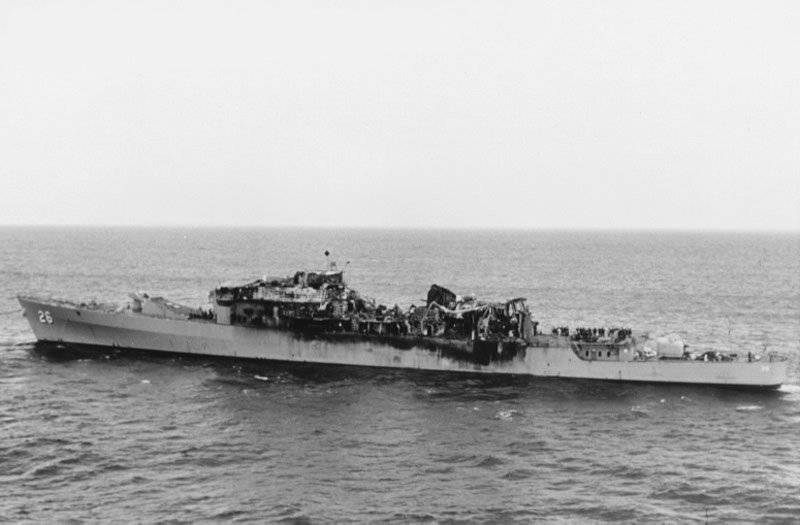
There is precedent for that. When the USS Belknap burned down to the damage control deck in 1975, she was moored in the Philadelphia Navy Yard until funds were allocated to repair her.


Belknap was, at the time of her fire, a newer ship than the Miami. However, the Fleet is a lot smaller than it was 37 years ago and the Navy isn't going to part with a valuable asset like a nuclear sub unless it absolutely has to.

Saturday, April 16, 2011

Flight Deck Fire

First, watch the video on Defense Tech.


I'm not going to address the reliability issue of the F/A-18s. That's outside my wheelhouse.

Note that the fire crews don't approach the burning jet from the rear. That's probably because there must have been at least 30 knots of relative wind over the flight deck, which might have increased if the Captain or OOD ordered up more speed to keep the flames blowing away from the flight crew. Spraying foam onto a fire is rather difficult if the wind is blowing in one's face.

You can also see that burning JP-5 dripped down into the catapult shuttle track.

The fire never reached the forward end of the jet, so the crew stayed with it. A flight-deck ejection might throw the crew over the side, which has its own risks.

Good work by the flight deck fire crews. That's what they practice for and it paid off.

(H/T)

Thursday, July 31, 2008

Damage Control Organization- the Repair Lockers

In an earlier post, I discussed the maintenance of damage control equipment on a divisional level. In this post, I will discuss the major location of damage control equipment, the Repair Locker. For the purposes of this discussion, I will consider a medium-sized warship, such as a destroyer, frigate or guided-missile cruiser.

Repair lockers contain the heavy damage control equipment and supplies. That is where you find dewatering equipment, shoring tools, portable cutting torches, oxygen level testers, axes, portable communications gear, hammers, just about everything needed for emergencies. The equipment in the repair lockers is maintained by R division. There are three repair lockers on the ship: Repair 2, Repair 5 and Repair 3. Repair 2 covers the forward part of the ship, Repair 5 covers the engineering spaces and Repair 3 covers the after part of the ship. If assistance has to be given to another ship (typically, in port), the Rescue and Assistance Detail operates out of Repair 3.

Each duty section in port has to have enough people in it to fully man both a repair team and a full security detail. At sea, emergencies that are severe enough to require handling from a repair locker are cause to go to battle stations. A report of a fire will trigger setting General Quarters (battle stations).

Repair lockers are manned from divisions shipwide. The Repair Locker Leaders, both in port and at sea, are generally from R Division. The first aid teams at the Repair Lockers are not the ship's corpsmen; the first aid teams stabilize injured personell and transport them to Sick Bay. (This, by the way, is a significant difference between civilian first aid and military first aid: Military first aid involves getting the injured out of the way, civilian first aid involves stabilizing the injured people in place until the paramedics come.) Repair 5 is staffed with engineers, as they will have to verify that the equipment in the space is shut down and, if necessary, do that task.

(A compartment, in Navy speak, is also referred to as a "space.")

The Repair Locker Leader stays at the Repair Locker to coordinate the casualty attack. The sailor in charge at the scene is the On-Scene Commander. Ideally, everyone in a repair team is cross-trained to be able to handle various jobs. Investigators go to the spaces surrounding the damaged area to check for collateral damage. Nozzlemen and hosemen fight the fires. Overhaulers take care of hot spots once the fire is out. Electricians cut power to the space(s) in question and rig casualty power (more on that another time). IC men run phone wires to set up communications between the On-Scene Commander and the Repair Locker Leader. There are sailors who test for explosive gasses and oxygen levels; until those conditions are safe, everyone in the space has to breathe using oxygen breathing gear.

At sea, the Repair Locker Leader reports to the Damage Control Assistant in DC Central. In port, the Repair Locker Leader reports to the Officer of the Deck.

Saturday, June 28, 2008

Damage Control Conditions

There are several different conditions of damage control readiness. Let’s take them from “least ready” to “most ready” and then tack on an exception.

Damage control conditions are identified by a letter. The letters are pronounced using the World War II phonetic alphabet. Damage control fillings are those openings between compartments and decks, other than piping systems.

If the ship is in a condition that requires a certain class of fitting to be closed and you need to open it, you must obtain permission and enter the exception into the Damage Control Log. The DC Log is kept in Damage Control Central at all times underway and during working hours in port. If there is no DCC watch in port, after working hours, the DC Log will be kept on the Quarterdeck.

CONDITION X-RAY: X-Ray fittings are always closed. All other fittings may be open and closed at will.

CONDITION YOKE: Yoke and X-Ray fittings are closed. This is the condition that is set in-port after working hours. Condition Yoke is generally set at-sea, but on a calm day, the ship may downgrade to Condition X-Ray to facilitate getting work done.

CONDITION DOG ZEBRA: Dog Zebra fittings are identified by a red “D” surrounding a black “Z”. Dog Zebra fittings are closed during Condition Zebra and also at sunset when the word is passed to “Set `Darken Ship’,” which is set while the ship is underway. You should not see any light emanating from a warship that is underway at night, other than the required navigation lights (this does not apply to aircraft carriers, which are lit up like a Vegas casino). Dog Zebra is set during Condition Yoke, obviously, they would be closed anyway during Condition Zebra.

CONDITION ZEBRA: Almost all fittings on the ship are closed. Condition Zebra is set during battle stations. Besides doors and hatches, wastewater drain lines are closed.

CONDITION CIRCLE WILLIAM: Circle William is only set during an alert against an attack by nuclear, biological and chemical weapons. Circle William is generally only set at battle stations. All air vents into the ship are closed. On a steam ship, you do not want to do this for very long, as the air temperatures in the firerooms will approach 140degF.

CONDITION WILLIAM: William fittings are always left open unless there is a specific need to shut one. These are things such as the seawater intakes and discharges to the condensers, the seawater intakes to the firepumps and the evaporators and the air intakes to the boilers.

The exception is fittings marked with a letter with a circle; Circle X-Ray and so on. You may open a circle fitting, pass through it, and then close it without permission. Hatches are generally Zebra fittings; the scuttles set into the hatches are generally Circle X-Ray fittings. The pass-through scuttles in the gun magazines, where powder and projectiles are passed from the magazines to the handling room are generally Circle X-Ray. Most such fittings are marked Circle X-Ray, a few interior watertight doors may be Circle Zebra, but those are rare and are usually located in the superstructure.

Thursday, June 26, 2008

Damage Control Organization: the DCPO

This post will begin the topic of damage control readiness. There were several facets to damage control readiness. In-port damage control was different from at-sea damage control. There were differences between who maintained the major stores of damage control equipment and who maintained the damage control equipment that was scattered about the ship. This post will talk about the latter point: Shipwide damage control maintenance.

Every part of the ship was sectioned off into the responsibilities of different divisions, which was generally done during pre-commissioning and then set in stone for the life of the ship. Generally, if a space contained mainly the equipment or machinery of a division, that division maintained the space, including all of the damage control equipment in the space. On a bulkhead of every space was a sign which gave the space designation (another time) and the division responsible.

That division was responsible for the cleanliness and preservation of that space and any fanrooms that had an access door into the space (“fanrooms” were part of the HVAC system, they were where the vent fans and heat exchangers were located, they were also a place to go hide to cop a nap). That division had to maintain the damage control equipment in the space, which included fire extinguishers, fire hoses, doors and, most importantly, watertight closures. Of course, there were watertight doors and hatches at bulkheads and decks that were the boundary lines between divisions. The rule here was that if the hatch or door opened into your space, you owned it.

One or two sailors from each division was assigned the full-time job of maintaining the damage control equipment in the division. The sailors were known as “Damage Control Petty Officers” and they served six-month tours as DCPOs. Other than their watches, the DCPOs worked for the Damage Control Assistant. The DCA and the senior enlisted of R division supervised the work of the DCPOs. The DCPOs also were spot-checked by their regular division officer.

Some of the work was relatively easy. Fire extinguishers had to be periodically weighed. Fire hoses had to be hydrostatically tested, but not terribly often, and the test dates were stenciled on the hoses. The DCPOs biggest headaches were the doors.

(By the way: "Hatches" are openings between decks, you climb up and down through a hatch. "Doors" are openings between compartments located on the same deck, you walk through a door. "Scuttles" are small round openings that you have to squeeze through; they are generally set in hatches, but not always. Calling a "door" a "hatch" is a landsman's mistake.)

The worst headache were the non-watertight doors, known as “joiner doors.” Most joiner doors had hydraulic door closers on them, just as you’d find on a screen door. Some of them were opened and closed several hundred times a day and they just got beat to shit. They were also high-visibility items for the XO, who would get viciously sarcastic if they were not working.

Closing a watertight door or hatch was known as “dogging it down.” Watertight hatches were dogged down by bolts that swung up from the hatch combing to engage recesses in the hatch. Obviously, hatches could not be opened from below, so every hatch had a scuttle in it that could be opened from either side. The scuttles were generally 18" in diameter; if you were too fat to fit through a scuttle, that could be a real problem. Hatches inside the ship were left open unless the ship was at battle stations. It took at least two sailors to safely open and close a hatch, as one had to hold the hatch up while the other either connected or disconnected the two metal poles that held the hatch open. (To prevent the support poles from being jarred lose, they were held in place with toggle pins, as having a hatch slam down on you would really fuck up your day, possibly forever.) In an emergency, one sailor could pull the locking pins, kick out the supports and let the hatch slam down, but that was very heavily frowned upon.

Watertight doors were either quick-acting or not. A quick-acting watertight door (QAWTD) had a lever or a wheel that was connected to the dogging levers, which pulled the door tight. The doors that were not, just known as "watertight doors" had individual dogging levers set around the frame of the door.

The QATD is on the right, the WTD is on the left.

The dogging levers could be operated from either side of the door and were tightened with a “dogging wrench,” which was a short section of pipe that fit over the end of the lever. The dogging levers on all types of watertight doors had to be kept adjusted so that when the door was dogged down, there was even pressure on the gaskets. The rubber gaskets around the edges of the hatches and doors had to be kept lightly lubricated with petroleum jelly to keep them in good condition and they were replaced at the first sign of deterioration.

The DCPOs who did the best jobs were basically invisible, for like everything in Engineering, if it worked right and was reliable, nobody really paid it much notice. But if it didn’t work, there was hell to pay. Damage control gear that didn’t work could cost lives and possibly result in the loss of the ship. Smart officers paid attention to damage control and frequently spot-checked the work of the DCPOs, which had the additional benefit of letting the DCPOs know that their work was important and was appreciated.

Friday, June 6, 2008

Fire, Fire, Fire in Compartment.....

Of all the bad things that can happen at sea, probably nothing is more dreaded than a fire. Fire is what everyone trains for. Fire is why every sailor on every ship is required to complete a damage control qualification after reporting to each new ship.

Fire is why there is very little wood on a Navy ship. Other than a few decorative plaques, the only wood to be found on a modern Navy ship are the 4x4s used for shoring up damage and some plugs and wedges used for stopping leaks. This is a lesson that was learned with blood in the early days of World War II. You will not find a wooden ladder ("staircase" to you landlubbers) or wooden furniture. If you were to go into the Wardroom of a naval ship (the place where the officers eat and where the supply officers hang out), the furniture may look like they are made of wood and the bulkheads ("walls") may look as though they are wood, but it is all contact paper over metal.

The Navy is justifiably proud of its expertise in damage control. The rumor around the Fleet was that one of the reasons the HMS Sheffield was lost to an Argentinian Exocet missile was because the ship had wooden fixtures and ladders in parts of the ship and those items caught fire. The USS Stark was hit by two Iraqi Exocets. The one missile that hit the Sheffield did not detonate, while one of the Exocets that hit the Stark did explode. The USS Stark, after putting out the fires and stabilizing the damage, sailed away and eventually returned to the US under its own power.

There are a lot of factors that come into play, not the least being the prevailing weather and where the missiles struck, so the difference in the damage control readiness of the two ships may not be dispositive. The rumor was, however, that the British rapidly stripped their warships of wooden fixtures and furnishings.

If you look at a photo of a warship, you will see watertight hatches and doors. This photograph is from some civilian rustbucket:

Note the rubber gasket around the edge.

Now look at this photo (which is small):


The round door is called a "scuttle" and it is in the center of a larger hatch. You can see that there is a raised ring onto which the scuttle seats. That is called a "knife edge;" as you turn the locking wheel to tighten the scuttle down, the rubber gasket is mashed into the knife edge and that is what makes the closure watertight. If you now look back at the rustbucket's watertight door, you will see that the gasket is shot. It will be no more watertight than the average sieve.

Navy ships have a lot of watertight hatches and doors. It is the job of the Damage Control Petty Officer(s) (DCPO) in each division to maintain the WTHs and WTDs in the division's spaces. It is a pain to replace the gaskets, but the gaskets must be kept lubricated (with basically petroleum jelly) and replaced when they deteriorate. This is not rocket science, this is Damage Control 101.

At one point, I was invited to take a tour of a NATO warship. The ship was fairly new, was chock-a-block with weapon systems in a way that USN warships, which were designed to be able to remain at sea for much longer periods of time, were not. But as I walked around on the tour, I noticed that on every open watertight door and hatch, the gaskets were rotten. They were all shrunken, dried out and cracked. That warship had no watertight integrity and, in the event of a fire, it could not be made smoketight. The warship looked nice, it was clean and well-painted.

But it could not take a punch.

Damage control is the last line of defense against a loss of the ship. The USS Stark arguably seriously screwed up in its combat readiness, which is why she took two missile hits. But because her damage control was up to snuff, she survived and her crew came home.

The paramount importance of damage control readiness is a lesson the Navy learned the hard way. I doubt very much it has ever been forgotten.